News

Machine voice. Your device's own speech engine reads Wikipedia's In the news word for word, then where each comes from. Nothing is sent anywhere.

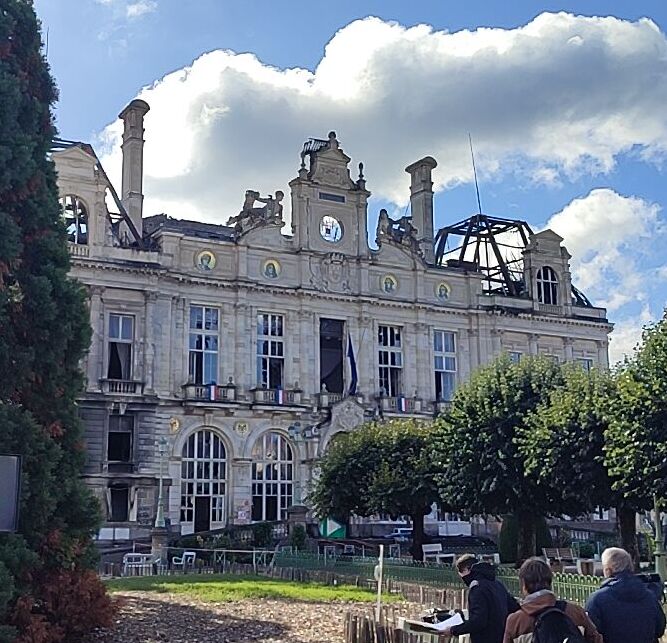
Hôtel de Ville the day after the fire

Law and crime• Posted to Wikipedia's In the news 19 Oct 02:24 UTC

2026 French student protests

The Hôtel de Ville in Limoges is partially destroyed by arson as fuel and student protests escalate in France.

What changed (17 Oct): Over 500,000 people take part in protests across France, according to the national trade union confederation, while clashes and riots erupt in large cities. Wikipedia, Current events

Cited by WikipediaFranceInfoCNewsOuest-FranceBFMTV+1 more

The story
Coverage of 2026 French student protests

Cited by Wikipedia's editors

Country and owner as Wikidata states them for the item whose official website is the cited address (DERIVED).

What Browse cannot tell yet

Which of these reported first, which carried another's wire copy, and which confirmed it independently: that needs the articles' text, which Browse does not hold. Several outlets covering something shows attention, not independent confirmation. The Wikipedia article lists its own sources.

Explore the coverage

7 Oct

Spillover of the 2026 French lycée protests

For a second consecutive day, riots occur in Liège, Belgium, following earlier student protests, prompting authorities to close the Guillemins railway station and urge local businesses to shut down. Over 100 people are arrested.

Cited by WikipediaAl JazeeraRTBF in French

Story timeline

7 entries · Wikipedia's Current events, last 14 days
  1. Over 500,000 people take part in protests across France, according to the national trade union confederation, while clashes and riots erupt in large cities.
  2. Protesters force their way into Marseille's town hall and vandalize the interior before being dispersed.
  3. In Lille, protesters storm the city hall and damage the premises prior to being removed by security forces.
  4. Dozens of shops are looted across major French cities amid widespread rioting and civil unrest.

The past three days · 19 stories · 1 on the front above

Sources & methods
  • The stories on top are what Wikipedia's editors posted to In the news, in Wikipedia's order, then the stories its Current events listed most over three days (a count Browse makes). Each is named by its Wikipedia article. Browse writes no headline and no summary, and ranks nothing by its own judgement.
  • The feed is every Current events line, one row per story, newest date first; older days are under the date control, back to 2005.
  • What changed is the newest Current events line under the story, with its date; Posted is the time the item first appears in the In the news section's edit history.
  • Cited by Wikipedia names the outlets the editors cite for a line: not every outlet that covered it, and several outlets covering something shows attention, not independent confirmation.
  • Who says it. A cited outlet marked OFFICIAL is a government, court or agency's own record; OWN SITE or OWN ACCOUNT, a party the line names speaking for itself; a platform's name, a social post; no mark, a report by that outlet. Read from the address, never judged.
  • Pictures are free files (public domain, CC0, CC BY, CC BY-SA) that the story's own Wikipedia article shows, chosen in this order: a photo taken during the event, a file photo of a person, place or thing in it, a satellite image; a map is shown only whole, in the coverage. Flags, emblems, logos and charts are never used, and a story with no suitable picture has none. Each is labelled with what it is and credited, its caption is Wikipedia's, and it is served from browse.info so your browser contacts no other site.
  • Coverage is the public feeds of 26 publishers (who, and what each outlet's terms say), read the way a feed reader does, every ten minutes at most, by a reader that names itself and stops where robots.txt says so; of each item the link, the headline as the outlet wrote it, the time, the author and the categories are kept, never the text or a picture. Headlines are grouped by one printed rule, labelled DERIVED, each story headed by its earliest outlet's own words; Browse writes no headline and counts outlets once. An outlet that asks is removed within 48 hours.
  • Newsrooms are the headlines, authors and times of Voice of America (public domain), Global Voices (CC BY 3.0), The Conversation (CC BY-ND 4.0), ProPublica (CC BY-NC-ND 4.0), UN News (its terms) and Inside Climate News (CC BY-NC-ND 3.0), the last three a non-commercial use, which Browse is; each linked to the original, none of its text copied. Headlines are the pages the GDELT Project's crawlers read in their newest quarter-hour, in English or in 65 other languages when you pick one, by the page's own title and time and GDELT's name for the site, found through GDELT under its terms (unrestricted use, cited and linked), none of the text. Records are the White House's, the Federal Register's, the European Commission's, the UK Government's and the European Central Bank's own publications, with their own identifiers, and companies' own current reports as the SEC's EDGAR lists them.
  • Everything is read once for everyone every few minutes; NEW, what you follow, mute and save, and the reading density are kept on this device.
  • Mute an outlet or a site from a coverage list, the headline board or the newsrooms: it never appears again on this device, and a line it alone cites is hidden and counted. Near your places on the board keeps the pages whose places name a place you follow.
  • Not here: other publishers' feeds and headlines. Most publishers' terms keep their feeds to personal use, so Browse reads only the newsrooms whose licences say otherwise.

Wikipedia, In the news · revision 1380966229 · CC BY-SA 4.0