

Skip to content

Space

What is above us now: the Sun, the Earth seen from far away, the station overhead, the next launches, who is up there, and the Sun's weather.

The station overhead

The International Space Station, where Browse computes it is right now.

DERIVED
Latitude
14.68° N
Longitude
128.00° W
Altitude
414 km
Speed
27,604 km/h
Below it
Daylight
The station
In sunlight

Computed by Browse with SGP4 from orbital elements of 19 Nov 06:28 UTC (16 h old), which drift a few kilometres a day. Orbital elements: 18th Space Defense Squadron via Space-Track.org, retrieved from CelesTrak.

the next orbit the last 45 minutes launch sites below

When you can see it

Follow a place in Places and its next visible passes appear here, computed on this device.

Follow a place →

A visible pass: the station at least 10° above the horizon and in sunlight while the sky there is dark. Predicted from the same elements; your places are never sent anywhere for this.

Sky calendar

The next equinox or solstice, the Moon's phases and the next eclipses. Times in UTC and in your own time.

Seasons

  • December solsticeMon 21 Dec 2026, 20:50 UTCin 32 days
  • March equinoxSat 20 Mar 2027, 20:25 UTCin 121 days

Worked out by Browse with Jean Meeus's Astronomical Algorithms (chapter 27); within two minutes of the US Naval Observatory's tables.

The Moon's phases

  • Full moonTue 24 Nov 2026, 14:54 UTCin 5 days
  • Last quarterTue 1 Dec 2026, 06:09 UTCin 12 days
  • New moonWed 9 Dec 2026, 00:52 UTCin 20 days
  • First quarterThu 17 Dec 2026, 05:43 UTCin 28 days

Worked out by Browse (Meeus, chapter 49); within two minutes of the US Naval Observatory's list. Drawn as the northern hemisphere sees it.

Next eclipses

  1. Annular solar eclipseSat 6 Feb 2027, greatest eclipse 16:00:47 TD (16:00 UTC)Seen from: “S. America, Antarctica, w & s Africa” Annular path: “Chile, Argentina, Atlantic”in 79 days · NASA's map ↗
  2. Penumbral lunar eclipseSat 20 Feb 2027, greatest eclipse 23:14:06 TD (23:13 UTC)Seen from: “Americas, Europe, Africa, Asia”in 93 days · NASA's map ↗
  3. Penumbral lunar eclipseSun 18 Jul 2027, greatest eclipse 16:04:09 TD (16:03 UTC)Seen from: “e Africa, Asia, Australia, Pacific”in 241 days · NASA's map ↗
  4. Total solar eclipseMon 2 Aug 2027, greatest eclipse 10:07:49 TD (10:07 UTC)Seen from: “Africa, Europe, Mid East, w & s Asia” Total path: “Morocco, Spain, Algeria, Libya, Egypt, Saudi Arabia, Yemen, Somalia”in 256 days · NASA's map ↗

Eclipse Predictions by Fred Espenak, NASA's GSFC: solar and lunar tables, 2021 to 2030. TD is the time scale NASA predicts in, 69 seconds ahead of UTC. NASA's abbreviations: n = north, s = south, e = east, w = west, c = central.

“Except during the brief total phase of a total solar eclipse, when the Moon completely blocks the Sun’s bright face, it is not safe to look directly at the Sun without specialized eye protection for solar viewing.”

Next launches

As scheduled by the providers and recorded by The Space Devs.

FORECAST
  1. GoSpaceX · Falcon 9 Block 5

    USSF-317

    T−06:31:2120 Nov 04:32 UTC

    Vandenberg SFB, CA, USA · Low Earth Orbit · Government/Top Secret

    A classified mission for the United States Space Force.

  2. GoChina Aerospace Science and Technology Corporation · Long March 8A

    SatNet LEO Group TBD?

    NET, to the hour20 Nov 11:59 UTC

    Wenchang Space Launch Site, People's Republic of China · Low Earth Orbit · Communications

    A batch of 9 Low Earth Orbit communication satellites for the Chinese state owned SatNet constellation operated by the China Satellite Network Group.

  3. GoChina Aerospace Science and Technology Corporation · Long March 6C

    Unknown Payload

    NET, to the hour21 Nov 03:50 UTC

    Taiyuan Satellite Launch Center, People's Republic of China · orbit and mission type: Unknown (The Space Devs)

    Details TBD.

  4. GoSpaceX · Falcon 9 Block 5

    NROL-136

    T−1d 14:28:2621 Nov 12:30 UTC

    Vandenberg SFB, CA, USA · Low Earth Orbit · Government/Top Secret

    Fifteenth batch of satellites for a reconnaissance satellite constellation built by SpaceX and Northrop Grumman for the National Reconnaissance Office to provide imaging and other reconnaissance capabilities.

  5. GoArianespace · Ariane 64 Block 2

    Amazon Leo (LE-04)

    T−3d 13:07:2623 Nov 11:09 UTC

    Guiana Space Centre, French Guiana · Low Earth Orbit · Communications

    Amazon Leo, formerly known as Project Kuiper, is a mega constellation of satellites in Low Earth Orbit that will offer broadband internet access, this constellation will be managed by Kuiper Systems LLC, a subsidiary of Amazon.

  6. GoSpaceX · Falcon 9 Block 5

    USSF-266

    T−3d 18:02:2623 Nov 16:04 UTC

    Vandenberg SFB, CA, USA · Polar Orbit · Government/Top Secret

    A classified mission for the United States Space Force.

Launch Library 2, The Space Devs, read 29 min ago. NET means no earlier than; dates move.

People in space

Who is off the planet right now.

STATISTIC

11 people

NASA

RFSA

CNSA

  • Zhu Yangzhu179 days up DERIVED
  • Zhang Zhiyuan179 days up DERIVED
  • Lai Ka-ying179 days up DERIVED

CSA

CCCP

  • Laika25218 days up DERIVED

The Space Devs' list of astronauts in space, read 31 min ago; days up counted by Browse from each one's launch.

Space weather

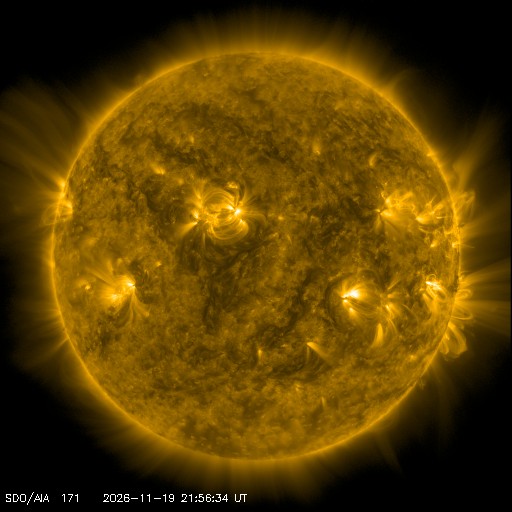
The Sun's activity and what it does to Earth's magnetic field, from NOAA.

What the Sun has been doing →On the live wall

Geomagnetic storms

NOAA G scale, 0 to 5

Geomagnetic activity: unsettledSWPC's word for Kp 3.00

G0 noneOBSERVED

Now, as NOAA stamped it 19 Nov 22:00 UTC

Highest in the past 24 hours: G1 · radio blackouts R1 · solar radiation S0 OBSERVED

  • 19 Nov 2026 FORECASTG0 none · R1 to R2 radio blackouts 15% · S1+ 1%
  • 20 Nov 2026 FORECASTG0 none · R1 to R2 radio blackouts 15% · S1+ 1%
  • 21 Nov 2026 FORECASTG0 none · R1 to R2 radio blackouts 15% · S1+ 1%
Evidence & method

NOAA's own scales: G for geomagnetic storms, R for radio blackouts, S for solar radiation storms. "Now" and the past 24 hours are observed; today and the next two days are NOAA's forecast, with its probabilities as it gives them.

Planetary K-index

0 to 9, every three hours

Kp 3.00OBSERVED

For the three hours from 19 Nov 18:00 UTC, from 8 stations

12 Novlow 0.3 · high 5.019 Nov

Highest in NOAA's forecast for the periods still to come: Kp 3.33, the three hours from 20 Nov 03:00 UTC FORECAST

Evidence & method

The chart shows only three-hour periods that had ended when Browse read the feed. NOAA's product labels some later periods "estimated" with its forecast's values, so any period that had not ended is shown as a FORECAST, whatever the feed calls it, and a forecast period that has ended since is no longer shown as ahead. Kp 5 is a G1 storm on NOAA's scale. "Quiet", "unsettled" and "active" are SWPC's glossary words for a-index ranges; Browse converts the Kp to ap with the standard table to choose one.

Alerts and warnings

NOAA SWPC ↗
  • ALERTSWPC WARNING (expected)21 h ago

    EXTENDED WARNING: Geomagnetic K-index of 4 expected

    WARK04, serial 5457 · issued 19 Nov 01:18 UTC

  • OBSERVEDSWPC ALERT (a threshold was reached)21 h ago

    ALERT: Geomagnetic K-index of 5

    ALTK05, serial 2063 · issued 19 Nov 01:08 UTC

  • ALERTSWPC WARNING (expected)21 h ago

    WARNING: Geomagnetic K-index of 5 expected

    WARK05, serial 2276 · issued 19 Nov 01:00 UTC

  • OBSERVEDSWPC ALERT (a threshold was reached)21 h ago

    ALERT: Geomagnetic K-index of 4

    ALTK04, serial 2698 · issued 19 Nov 00:46 UTC

  • ALERTSWPC WARNING (expected)21 h ago

    WARNING: Geomagnetic K-index of 4 expected

    WARK04, serial 5456 · issued 19 Nov 00:41 UTC

Evidence & method

SWPC's words, translated into Browse's: an SWPC ALERT means a threshold was reached, so it is OBSERVED here; a WARNING or a WATCH says something is expected, so it is an ALERT here, never the event; a SUMMARY says what happened. SWPC's own headline is quoted.

Source: NOAA Space Weather Prediction Center (public domain). Browse is not affiliated with or endorsed by NOAA.