
News, with the whole picture.
Get the gist. See what changed. Follow the story.
i
Read from 70 publishers' own feeds in 8 regions, Wikipedia, open newsrooms, public records and the GDELT Project, each at its own time.i
Machine voice. Your device's own speech engine reads Wikipedia's In the news word for word, then where each comes from. Nothing is sent anywhere.
Just in
From the publishers' own feeds: stories two or more outlets carry, newest first · read just now
Grouped by a printed rule DERIVED
Each headline is the outlet's own, linked to it; Browse writes none of them. The feeds are read every ten minutes at most, so a story here can be minutes old and not yet checked by anyone. A headline joins a story when it shares three or more words of four letters or more (names, places, things; common words set aside) with the story's first headline and was published within 48 hours of it. Unless four or more are shared, the shared words must include a name, or two words that stand side by side in both. A name is a word both headlines capitalise that the read's headlines mostly write with a capital away from their first word (Title Case headlines aside), carried by no more than one in a hundred of the stories (or six, when that is more); two capitalised words side by side in both, such as White House, are one name and count as one word. An everyday word counts half: one most headlines write in lower case that more than one in a hundred of the stories carry (and at least ten); it counts whole once the two share a name. Stories are counted once the headlines are grouped with every word whole. A headline joins the story it shares most with, and starts a new one when none matches. Then two stories of two or more headlines each, their first headlines within 48 hours of each other, become one when the words they share count three the same way (a word is shared when two or more headlines of one story, or one in five of a big story's, and one of the other's carry it); they share a name, or a pair of words side by side with a name in it that two headlines of each carry and no more stories than a name does; two of the shared words or pairs are as rare and are carried by enough headlines of both stories, or one when four or more words are shared; and the earlier first headline carries two of the shared words, one of them rare. The bigger story takes the smaller. A story's heading is its first headline, in that outlet's own words. Outlets are counted once each; a headline repeated word for word by several outlets is counted as one headline.


Your catch-up deck
Start with a story. Go as deep as you like.
How the deck chooses
The deck leads with the stories the most sources carried in the last day. Each registered publisher whose own feed has a headline on the story in the last 24 hours counts one; Wikipedia's editors count one when they added a line under it on today's or yesterday's Current events page, and one more when they posted it to In the news in the last 24 hours. A publishers' story joins a Wikipedia story when its first headline shares two or more long words with the story's name, a name of several words counting once. Ties go to the story that moved most recently, then to the one with more lines. Two stories on one event show once: a story whose name shares two or more long words with a story above it (by the same rule, a year not counting, nor a word one name writes as a name and the other as a common word) folds into that story, which says how many more outlets the folded one adds. A shared picture alone does not fold a story, since one file photo can picture several events. A story no source moved in that time leaves the deck, unless fewer than three moved. The counts are Browse's (DERIVED).
Ukraine strikes bridge connecting Russia to Crimea, causing ‘minor’ damage
 Global NewsEarliest in Browse's feeds 28 h ago · Newest 48 min ago
How coverage is grouped
The heading is Global News's own headline, the earliest in the 22 publishers' feeds Browse reads that carry it. Headlines join one story by a printed rule, and the counts are Browse's (DERIVED).
← → to move between storiesSwipe the story left or right to move between storiesYour pace. No auto-advance.
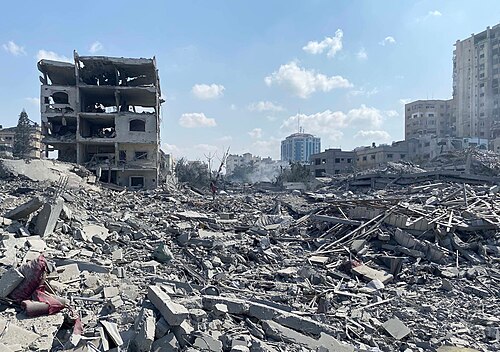
Middle Eastern crisis (2023–present)
Bahrain's military intercepts a number of drones fired by Iran's Islamic Revolutionary Guard Corps (IRGC) at Sheikh Isa Air Base.

2026 Iran war
Bahrain's military intercepts a number of drones fired by Iran's Islamic Revolutionary Guard Corps (IRGC) at Sheikh Isa Air Base.
2026 Bangladesh garment workers protests
Bangladeshi police and 42 platoons of the Border Guard Bangladesh deploy tear gas, stun grenades, batons, and surveillance drones during clashes with thousands of garment workers across Dhaka, Savar, Ashulia, Gazipur, and Narayanganj demanding a monthly minimum wage increase from ৳12,500 (US$100) to ৳30,000 ($240). Protesters block the N3, N4, and N5 highways and force the closure of at least 37 factories after a Minimum Wage Board meeting is postponed to November 23.
Story paths
2 connections between today's stories, through a shared topic or section.
 Middle Eastern crisis (2023–present)WorldBahrain's military intercepts a number of drones fired by Iran's Islamic Revolutionary Guard Corps (IRGC) at S…
Why these are connected
Lines under both link Israel Defense Forces on Wikipedia A reading order, never a cause.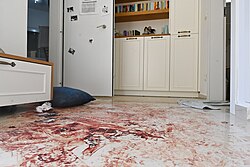 Gaza warWorldIsraeli military says that Al-Qassam Brigades commander Samir Abu Younis of the Rafah brigade, who helped plan…
 Crimea attacks (2022–present)WorldThe Crimean Bridge is struck by Ukrainian drones for the second day in a row, killing two people and prompting…
Why these are connected
Lines under both link Crimean Bridge on Wikipedia A reading order, never a cause.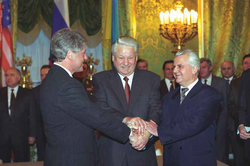 Russo-Ukrainian war (2022–present)WorldThe Crimean Bridge is struck by Ukrainian drones for the second day in a row, killing two people and prompting…
Latest, from every source
The outlets' and open newsrooms' newest headlines by their own times, beside the newest lines Wikipedia's editors listed.
From the outlets and newsrooms
Taliban ban cricket broadcasts in Afghanistan's Kandahar province
9 min ago · Voice of America
Google’s AI ultimatum exposes the risks of schools’ dependence on Big Tech
37 min ago · The Conversation
Street medicine vendors are dangerously filling Haiti’s healthcare gaps
7 h ago · Global Voices
The New Rules of Permitting
8 h ago · Inside Climate News
From Wikipedia's editors
Bahrain in the 2026 Iran war
Bahrain's military intercepts a number of drones fired by Iran's Islamic Revolutionary Guard Corps (IRGC) at Sheikh Isa Air Base.
Crimea attacks (2022–present)
The Crimean Bridge is struck by Ukrainian drones for the second day in a row, killing two people and prompting Russian authorities to close vehicle traffic again. Open-source intelligence report that a section of the road bridge damaged yesterday has collapsed into the Kerch Strait.
Following the arrest of party leaders, activists of the banned Awami League and Chhatra League mobilize via mosque loudspeakers and storm and set fire to a police station in Tungipara, Gopalganj District, Bangladesh, freeing detainees and looting firearms as police fire tear gas and rubber bullets, before the attackers also burn the residence of Bangladesh Nationalist Party Member of Parliament S M Jilani of Gopalganj-3 and blockade local roads.
Wikipedia · Current events

Canada–China relations
Canada and China agree to further tariff reductions following talks between Canadian prime minister Mark Carney and Chinese leader Xi Jinping before the APEC summit in Shenzhen. China reduces tariffs on C$400 million (¥1.8 billion) in Canadian exports, while Canada extends relief for Chinese steel and aluminium.
Explore the coverage
The outlets that carry the lead story, in their own feeds and their own words.
Ukraine strikes bridge connecting Russia to Crimea, causing ‘minor’ damage
22 outlets carry it in their own feeds.
How the outlets are grouped
Each outlet is named as its own feed names itself, linked to its article. Headlines join one story by a printed rule (shared words within 48 hours), counted by Browse (DERIVED). Several outlets covering one thing shows attention, not independent confirmation.
You've reached the end of this brief.
The stories the most sources carried today, from the publishers' own feeds and Wikipedia's editors. Keep exploring, or come back for what changes.
The past three days · 45 stories
Bahrain in the 2026 Iran war
Bahrain's military intercepts a number of drones fired by Iran's Islamic Revolutionary Guard Corps (IRGC) at Sheikh Isa Air Base.

2026 Iran war
The United States Air Force conducts a series of at least six strikes on Qeshm Island. The IRGC shoots down a General Atomics MQ-9 Reaper drone south of the island.
Crimea attacks (2022–present)
The Crimean Bridge is struck by Ukrainian drones for the second day in a row, killing two people and prompting Russian authorities to close vehicle traffic again. Open-source intelligence report that a section of the road bridge damaged yesterday has collapsed into the Kerch Strait.
Following the arrest of party leaders, activists of the banned Awami League and Chhatra League mobilize via mosque loudspeakers and storm and set fire to a police station in Tungipara, Gopalganj District, Bangladesh, freeing detainees and looting firearms as police fire tear gas and rubber bullets, before the attackers also burn the residence of Bangladesh Nationalist Party Member of Parliament S M Jilani of Gopalganj-3 and blockade local roads.
2026 Bangladesh garment workers protests
Bangladeshi police and 42 platoons of the Border Guard Bangladesh deploy tear gas, stun grenades, batons, and surveillance drones during clashes with thousands of garment workers across Dhaka, Savar, Ashulia, Gazipur, and Narayanganj demanding a monthly minimum wage increase from ৳12,500 (US$100) to ৳30,000 ($240). Protesters block the N3, N4, and N5 highways and force the closure of at least 37 factories after a Minimum Wage Board meeting is postponed to November 23.
Canada–China relations
Canada and China agree to further tariff reductions following talks between Canadian prime minister Mark Carney and Chinese leader Xi Jinping before the APEC summit in Shenzhen. China reduces tariffs on C$400 million (¥1.8 billion) in Canadian exports, while Canada extends relief for Chinese steel and aluminium.

2026 Russian Air Force Antonov An-12 crash
A Russian Air Force Antonov An-12 crash near Kemerovo, Russia, killing all 19 people on board.
Forty-six people are injured after a collision between two trains in Prague, Czech Republic.
Measles resurgence in the Americas
The Pan American Health Organization revokes measles elimination status of Bolivia, Mexico, and the United States. For the U.S., the organization cited continuous domestic transmission for over 12 months amid more than 5,700 reported infections and multiple deaths in 2026.

France–Malaysia relations
France and Malaysia establish a strategic partnership, signing agreements on defence, energy, and technology cooperation during French president Emmanuel Macron's state visit. Malaysia also agrees to permit limited exports of unprocessed rare-earth minerals to France in exchange for assistance with mineral processing.
Israel–United Kingdom relations
UK Foreign Secretary Ed Miliband announces that the UK will sanction eight companies involved in the construction of settlements in the occupied West Bank, as well as Tzav 9 for its role in blocking humanitarian aid to the Gaza Strip.
Corruption in Mongolia
Mongolian president Ukhnaagiin Khürelsükh announces his resignation from office, three days after former Ulaanbaatar mayor Khishgeegiin Nyambaatar accused him of past embezzlement from a railway project during his tenure as prime minister. The State Great Khural must accept the resignation for it to become effective.
Wikipedia, Current events, 2026-11-17 · revision 1386307519 · CC BY-SA 4.0
Wikipedia, Current events, 2026-11-16 · revision 1386227793 · CC BY-SA 4.0
Wikipedia, Current events, 2026-11-15 · revision 1386111400 · CC BY-SA 4.0
Sources & methods
- The deck. The deck leads with the stories the most sources carried in the last day. Each registered publisher whose own feed has a headline on the story in the last 24 hours counts one; Wikipedia's editors count one when they added a line under it on today's or yesterday's Current events page, and one more when they posted it to In the news in the last 24 hours. A publishers' story joins a Wikipedia story when its first headline shares two or more long words with the story's name, a name of several words counting once. Ties go to the story that moved most recently, then to the one with more lines. Two stories on one event show once: a story whose name shares two or more long words with a story above it (by the same rule, a year not counting, nor a word one name writes as a name and the other as a common word) folds into that story, which says how many more outlets the folded one adds. A shared picture alone does not fold a story, since one file photo can picture several events. A story no source moved in that time leaves the deck, unless fewer than three moved. The counts are Browse's (DERIVED). Just in, above it, shows the stories two or more registered publishers' own feeds carry from the last six hours, each headed by its earliest outlet's own headline. Browse writes no headline and no summary, and ranks nothing by its own judgement.
- The feed is every Current events line, one row per story, newest date first; older days are under the date control, back to 2005.
- What changed is the newest Current events line under the story, with its date; Posted is the time the item first appears in the In the news section's edit history.
- Sources, on a story, names the outlets Wikipedia's editors cite for its lines: not every outlet that covered it, and several outlets covering something shows attention, not independent confirmation.
- Who says it. A cited outlet marked OFFICIAL is a government, court or agency's own record; OWN SITE or OWN ACCOUNT, a party the line names speaking for itself; a platform's name, a social post; no mark, a report by that outlet. Read from the address, never judged.
- Pictures are free files (public domain, CC0, CC BY, CC BY-SA) that the story's own Wikipedia article shows, chosen in this order: a photo taken during the event, a file photo of a person, place or thing in it, a satellite image; a map is shown only whole, in the coverage. Flags, emblems, logos and charts are never used, and a story with no suitable picture has none. Each is labelled with what it is and credited, its caption is Wikipedia's, and it is served from browse.info so your browser contacts no other site. Beside a publishers' story an outlet's own picture can show instead, credited to it and loaded from it, while Show pictures is on.
- Coverage is the public feeds of 70 publishers (who, and what each outlet's terms say), read the way a feed reader does, every ten minutes at most, by a reader that names itself and stops where robots.txt says so; of each item the link, the headline as the outlet wrote it, the time, the author and the categories are kept, never the text or a picture. Headlines are grouped by one printed rule, labelled DERIVED, each story headed by its earliest outlet's own words; Browse writes no headline and counts outlets once. Each outlet's dot is the colour of where the register says it is based, the region also named in words; “first seen by Browse” names the earliest headline in the feeds Browse reads, not who broke the story. An outlet that asks is removed within 48 hours.
- Newsrooms are the headlines, authors and times of Voice of America (public domain), Global Voices (CC BY 3.0), The Conversation (CC BY-ND 4.0), ProPublica (CC BY-NC-ND 4.0), UN News (its terms) and Inside Climate News (CC BY-NC-ND 3.0), the last three a non-commercial use, which Browse is; each linked to the original, none of its text copied. Headlines are the pages the GDELT Project's crawlers read in their newest quarter-hour, in English or in 65 other languages when you pick one, by the page's own title and time and GDELT's name for the site, found through GDELT under its terms (unrestricted use, cited and linked), none of the text. Records are the White House's, the Federal Register's, the European Commission's, the UK Government's and the European Central Bank's own publications, with their own identifiers, and companies' own current reports as the SEC's EDGAR lists them.
- Everything is read once for everyone every few minutes; NEW, what you follow, mute and save, and the reading density are kept on this device.
- Mute an outlet or a site from its ··· menu in Coverage, a story's sources, the headline board or the newsrooms: it never appears again on this device, and a line it alone cites is hidden and counted. Near your places on the board keeps the pages whose places name a place you follow.
- Not here: any outlet's article text or summary, publishers' pictures, and publishers outside the register at /news/publishers.
Wikipedia, In the news · revision 1386286191 · CC BY-SA 4.0