
REFERENCE Wikipedia, read on Browse · 7 min read
Eurovision Song Contest Asia
International song competition
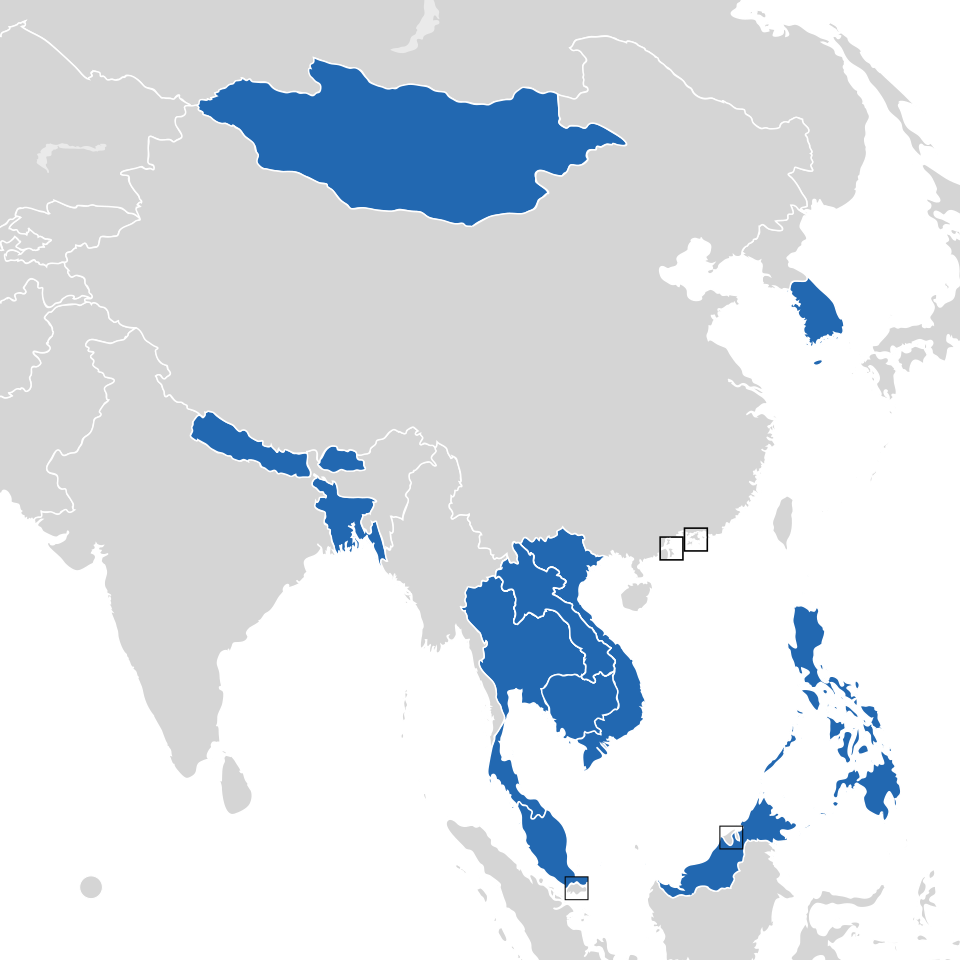
The Eurovision Song Contest Asia (ESCA) is an international song competition modeled after the Eurovision Song Contest, where broadcasters from the Asia-Pacific region will compete representing their countries. The inaugural edition, organised by Voxovation under licence from the European Broadcasting Union (EBU), produced by S2O Productions, and staged by host broadcaster Channel 3, was held on 14 November 2026 at One Bangkok Forum in Bangkok, Thailand, with broadcasters from eleven countries taking part.
Plans to adapt the Eurovision Song Contest for the Asia-Pacific region started in earnest in 2008. In 2016, Australia's Special Broadcasting Service (SBS) took on the project, developing a version of the format with Blink TV and the EBU for a planned debut in 2019. SBS shelved the project in 2021, and it was later handed over to Voxovation, a company created to develop adaptations of the contest format in different territories with licence from the EBU. No further updates were provided until 2025, when the Bhutan Broadcasting Service (BBS) aired a competition called Druk Dra, aimed at selecting its entry for a Eurovision Asia contest before Voxovation asked the broadcaster to halt it. On 31 March 2026, the EBU and Voxovation officially announced the competition, with Thailand as the host country and an initial lineup of ten participating countries, which was expanded to eleven in August 2026.
Development
In September 2008, the European Broadcasting Union (EBU) announced plans for an Asia-Pacific counterpart to the Eurovision Song Contest, scheduled for 2009. By March 2009, the competition had been named Our Sound – The Asia Pacific Song Contest, and was scheduled to be held in the second half of the year. The contest was to be coordinated by the Singapore-based company Asiavision, led by German entrepreneur Andreas Gerlach, with broadcasters from 16 countries and regions slated to participate: Cambodia, China, Hong Kong, India, Indonesia, Japan, Laos, Macao, Malaysia, Pakistan, the Philippines, Singapore, South Korea, Taiwan, Thailand, and Vietnam. The contest was subsequently postponed several times and ultimately never materialised.
In March 2016, the EBU began development on an adaptation of the Eurovision Song Contest for the region with Special Broadcasting Service (SBS). SBS was working on the project with its production partner Blink TV. The first contest was scheduled to be held in Australia in 2017. The official name of the competition was revealed to be Eurovision Asia Song Contest (or simply Eurovision Asia) in August 2017. By May, Australia, Hong Kong and Singapore had shown interest in hosting the first edition of the contest. The Singaporean government put forward S$4 million to host the event, while the city of Sydney and the state of New South Wales said they would invest in hosting. The city council of Gold Coast claimed in November 2018 that the first contest would take place at the Gold Coast Convention and Exhibition Centre from 30 November to 7 December 2019. In May 2021, it was confirmed that SBS had shelved the project.
SBS's plans from May 2016 were for one broadcaster from each country in the Asia-Pacific region to be eligible to compete, meaning there would be a maximum of 68 participants. Membership in the Asia-Pacific Broadcasting Union (ABU) would not be a requirement for participation. By March 2019, the broadcasters from ten countries had confirmed their intention to participate: Australia, China, Japan, Kazakhstan, Maldives, New Zealand, Papua New Guinea, Solomon Islands, South Korea and Vanuatu. SBS confirmed its participation, while China, Japan and South Korea were named as potential participants.
In May 2025, the Bhutan Broadcasting Service (BBS) confirmed its intention to participate in Eurovision Asia, stating that the inaugural contest would be held in Bangkok, Thailand, with 18 countries participating. On 24 June, the EBU published its Brand Impact Report for the Eurovision Song Contest, listing an adaptation in Asia-Pacific as under "ongoing development". In August, the location was instead stated by BBS as Mumbai, India, as it began organising a national selection titled Druk Dra that same month to select its entry. Additionally, Ho Chi Minh City Television (HTV), which serves Vietnam's Ho Chi Minh City area, had initially allocated a timeslot for a programme titled Eurovision Asia on 31 August. On 28 August, Martin Green, director of the Eurovision Song Contest, stated that "no plans have been confirmed or announced to date" for the contest in Asia-Pacific, further clarifying that Druk Dra was taken off air and deleted from online platforms at the request of the EBU's partners. In November, Marcus Tang was hired by Voxovation to serve as "Managing Director Asia". On 15 December, Christer Björkman, Head of Music and Founder at Voxovation, stated in the Eurovision Uncovered podcast that Eurovision Asia was ongoing "intensive preparations", with hopes of a public reveal "quite soon". In an interview, Green said that the national broadcasters in Asia-Pacific appreciated the contest as a way of giving a chance to national pop stars, portraying it as a "no-brainer". The name "Eurovision" was included in the title, despite the event consisting of Asian-Pacific participants, at the request of the prospective participating broadcasters.
2026 contest
On 29 March 2026, a website was launched, claiming that the contest would take place on 14 November in Bangkok, provisionally featuring nine countries: Bangladesh, Bhutan, Cambodia, Laos, Malaysia, Nepal, the Philippines, Thailand, and Vietnam. The website was temporarily taken offline a few hours later. The contest was formally announced on 31 March under the name Eurovision Song Contest Asia, to be organised by the EBU and Voxovation with S2O Productions serving as partners, and Thailand's Channel 3 serving as the host broadcaster. The initial announcement listed ten countries (the aforementioned plus South Korea) alongside their respective participating broadcasters. Mongolia's participation was confirmed on 14 August.
Production and format
On 31 March 2026, the EBU, Voxovation, and S2O Productions announced that the inaugural edition of the contest would be held on 14 November 2026 in Bangkok, Thailand; the venue was confirmed to be One Bangkok Forum on 21 September. Each competing entry must be under three minutes and performed by no more than six people. Participating broadcasters from all countries organised national finals to select their entries except Malaysia, which used an internal selection instead. The winner would be invited to perform as a guest at the Eurovision Song Contest 2027 in Burgas, Bulgaria.
Woody Milintachinda and Cindy Bishop were announced as the presenters of the show on 25 September. Preparations at the contest venue began on 2 November, with the construction of the main stage. The first rehearsals with the artists took place between 8 and 10 November, followed by the second rehearsals on 11 and 12 November.
Voting system
The official voting rules for the contest were released on 9 November 2026. The results were decided by a 50/50 split of professional jury voting and public voting. Viewers were able to vote up to eight times for free, and also cast up to 10 optional 'booster' votes. Every viewer were required to vote for at least three entries. As in the main Eurovision Song Contest, viewers in the participating countries were not allowed to vote for their own country. Viewers from non-participating countries were able to vote in all shows, with their votes being aggregated and presented as one individual set of points under "Rest of the World".
Participants
Eligibility for participation in the contest covers both public service and privately-funded broadcasters in the Asian-Pacific region. The EBU has also confirmed that broadcasters taking part in the main Eurovision Song Contest will not be eligible to take part in the Asian-Pacific counterpart, meaning that those from countries in the Asian-Pacific region may not be able to take part whilst doing so in the main contest, such as SBS (Australia).
On 11 September 2026, broadcasters from 11 countries were announced to be participating in the inaugural edition. Prior to the contest, a digital compilation album featuring all the songs, except Thailand's entry, was put together by Voxovation and released by Dao Music Entertainment on 6 November.
Contest overview
The event took place on 14 November 2026 at 20:30 ICT. Eleven countries participated, with the running order published on 29 October.
Before the show went live, Jamal performed as a warm-up act. The show began with a flag parade, introducing the eleven competing artists who entered the stage in tuk tuks. Due to technical issues during Thinla's performance, a recording of Laos' jury show performance was shown after all eleven songs were performed. The interval acts included Eurovision Song Contest 2026 winner Dara performing a mashup of her new single "Bad Idea" and her winning song "Bangaranga", and Jeff Satur performing a medley of his songs "Black Tie" and "Grief Eaters".
The winner was the Philippines with the song "Sobra-Sobra", performed by Carmelle and written by Gianina Camille del Rosario and Mart Sam Emmanuel Olavides. The Philippines won both the jury and online vote, with Thailand, Vietnam, Malaysia, and Laos completing the top five.
Spokespersons
The following spokespersons announced the top three scores from each country's national jury:
Broadcasts
Each participating broadcaster aired the contest live nationally, and the EBU streamed it internationally on its Eurovision Song Contest YouTube channel. Tommy Hatto provided English-language commentary for broadcasters that offer second audio programs. The tables below detail the broadcasting plans and commentators for the countries that aired the contest.