
REFERENCE Wikipedia, read on Browse · 14 min read
Suicide of Razis
Suicide described in 2 Maccabees
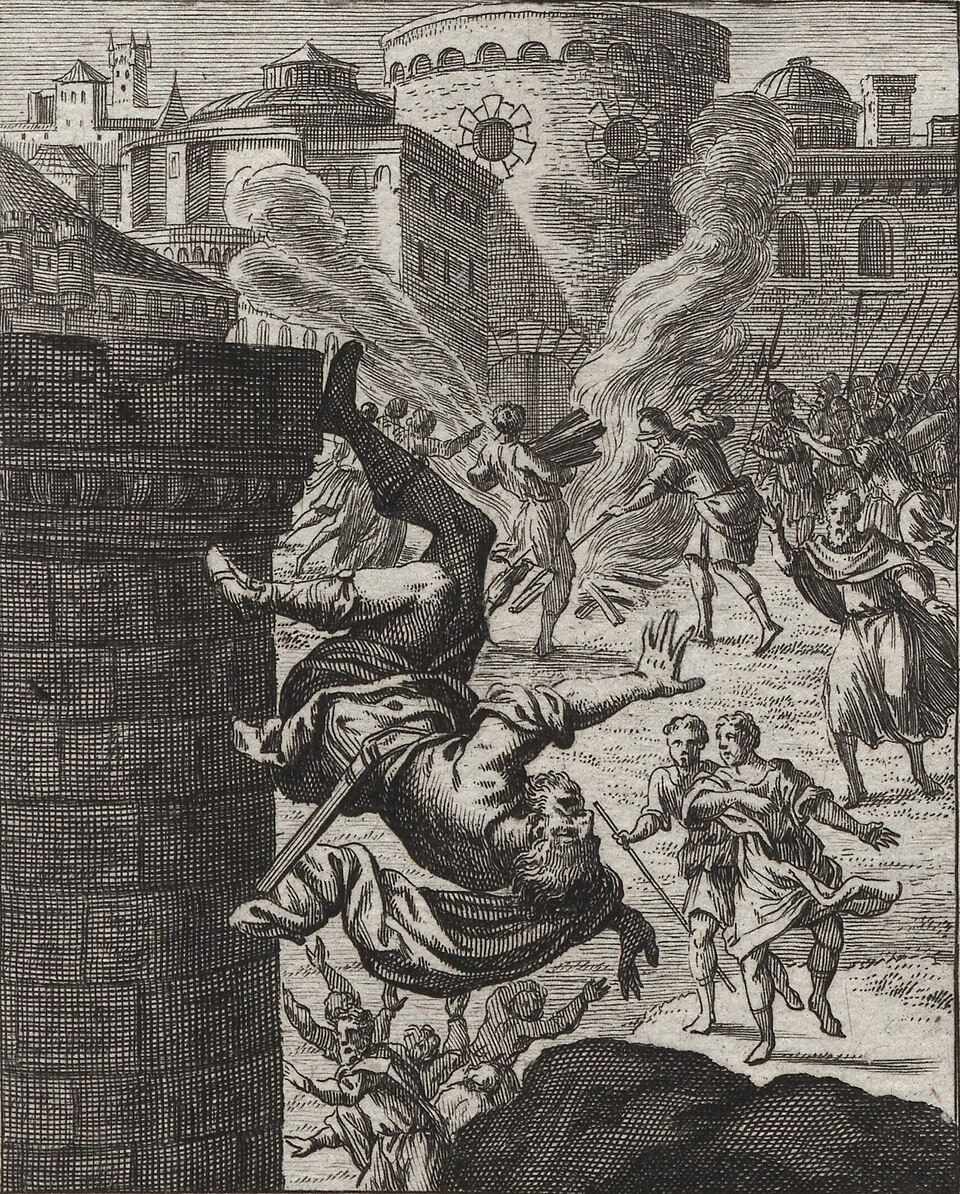
The suicide of Razis is described in 2 Maccabees, as part of its narrative of the Maccabean Revolt. According to the book, the Seleucid governor Nicanor was after Judas Maccabeus, who led the revolt. Nicanor sent 500 troops to arrest Razis, a Jerusalem elder known as "the father of the Jews," to make an example out of him and strike a blow to the Jewish community. Faced by the crowd of soldiers who set fire to his tower, preferring a noble death over capture, Razis first tried to fall upon his sword, and when that failed, hurled himself off the wall into the enemy ranks below. Surviving the fall despite severe injuries, Razis charged through the crowd, tore out his own entrails, and threw them at the soldiers while praying for his resurrection with his dying breath.
Scholars interpret Razis's suicide not merely as an act of desperation, but as a deliberate and performative ritual response to Seleucid persecution and internal betrayal. By throwing his own entrails at the surrounding enemy troops, they say Razis sought to ritually defile and spiritually neutralize his Gentile adversaries. Scholars say that the story of Razis's self-disembowelment and the hurling of his organs toward the crowd is without peer in Jewish tradition or in any other tradition.
Rather than viewing suicide negatively as in the Hebrew Bible, 2 Maccabees presents Razis's self-inflicted violence as a sacrificial act of divine wrath on behalf of the community. Furthermore, scholars have analyzed Razis as a model citizen of the Jerusalem polis whose honorific title, "father of the Jews," mirrors Graeco-Roman civic honors like pater patriae. By choosing to die nobly to avoid humiliating outrages at the hands of sinners, Razis stands as a loyal counterpart to Judas Maccabeus and a direct antithesis to high priest Alcimus, who had voluntarily defiled himself during crisis.
The origin of Razis's name is also debated, with scholars proposing Hebrew, biblical, or Persian origins. Although the epitomist approved of the suicide, later Christians diverged from this view. The story's historicity has been questioned, with some scholars proposing alternatives to parts of the narrative.
Meaning of Razis's name
The name Razis is not documented for any other Jew, and has several variations. While in the original Greek copies of the 2 Maccabees Razis's name is spelled Ραζὶς, variations of the name exist, and some scholars have suggested that the spelling Pαξις should be accepted instead, "due to frequent confusion of ζ and ξ".
Some scholars relate the name to the Hebrew word razi (רָזִי) in Isa 24:16, the meaning of which is unclear, with Jonathan Goldstein further tying the name to the repeated רָזִי-לִי רָזִי-לִי (translated by him as "I pine away, I pine away") in the same verse, proposing that Isa 24:16–18 prophesies Razis's death. Wilibald Grimm also says the name is "a nickname based on his fate", saying that the name stems from the Hebrew רזי (translated by him as "leannes, wasting, destruction"). Carl Friedrich Keil proposed a link to ratsa (רצה), meaning "favour". van Henten stated parallels can be drawn between "Razis" and the Hebrew root רצ"ה, used in Rabbinical literature to mean "appease" or "effect atonement".
Some scholars, such as Martin Schwartz, argue that the name has Iranian origins. Martin Schwarz compared "Razis" with the Avestan Frārāzi-, Bagorazos and Phandarazos. Rāzan and rāzah mean "arrangement," "setting in order" or "preparation." Schwarz says Razis's name could be a shortened version of one of the aforementioned Avestan names. Aya Barsky-Elishav also suggests Iranian origins, linking the name with the Persian raz, meaning "secret".
Background
In 2 Maccabees, Razis's death takes place amid Seleucid oppression of the Jewish people. Measures were introduced to abolish Jewish law and practices, making Greek customs obligatory. These measures profaned the temple, banned Jewish festivals and Sabbath observance, and may have even forbidden openly confessing to being a Jew. Jews were compelled to consume defiling foods and renounce Judaism, or be tortured to death.
2 Maccabees 14 describes the events leading up to the suicide of Razis. Following the rise of the new Seleucid king Demetrius I Soter in 162 BCE, Alcimus applied and regained the high priesthood. It tells that after regaining his status, Alcimus convinced the king that peace in Judea required eliminating Judas Maccabaeus. Nicanor was appointed governor of Judea to defeat Judas. While adopting a peaceful approach at first, a second visit by Alcimus to the king forced Nicanor to act against Judas; Judas subsequently went into hiding. When the temple priests refused to surrender Judas, Nicanor swore that he would raze the sanctuary to the ground, tear down the altar, and erect a temple to Dionysus in its place. The priests prayed to God to defend the temple.
The attempted arrest of Razis and his suicide are then described. Razis's story gave Judas and his men time to move to Samaria, and gave Nicanor time to hear of that. A battle between Judas Maccabeus's men and Nicanor then ensued, the Battle of Adasa.
Events
The text tells that prior to the incident, Razis, a Jerusalem elder, "had brought in a decision for Judaism". It is unclear what this passage means. Several scholars have proposed that this may indicate that Razis had been tried under previous Seleucid administrations, but this interpretation leaves open the question of why Razis didn't end up like those who had been tried in chapters 6 and 7. Razis was a revered figure among the Jews and was called "the father of the Jews" due to how much he loved his people.
According to the book, Nicanor ordered over 500 soldiers to arrest him in order to set an example and strike a blow against the Jewish community. The soldiers surrounded and besieged the multi-story tower (pyrgos) where Razis was located, setting fire to the doors to trap him inside. Preferring to die nobly rather than be captured and subjected to outrages by his enemies, Razis fell upon his own sword. Due to the haste and distress of the moment, the sword did not hit any vital organs and failed to kill him.
2 Maccabees then tells that Razis climbed up to the wall of the structure and hurled himself down into the mass of enemy soldiers below. The soldiers quickly pulled back to avoid his falling body, clearing a space where Razis then hit the ground. Despite severe injuries from both the sword wound and the fall, Razis rose in a fury, and ran through the ranks of the enemy crowd as his blood spilled on them. Reaching a steep rock, Razis used both hands to tear out his own entrails and hurled them into the crowd of soldiers. With his final breath, he called upon the "Lord of life and spirit" to restore his body parts to him after his death.
Analysis
The overall account is rather abrupt without much setup, possibly due to the epitomist omitting text as part of the abridgment; it does not explain if Nicanor had a more specific reason than distaste for the Jews to order the arrest of Razis, and if Razis knew of Judas's location, why 500 men were necessary, or how Razis ended up in a fortified tower. Menahem Stern proposes that he was targeted since he was "one of the most prominent opposers of Nicanor's policies".
Theological reception
Theologically, the compiler of the text approves of Razis's suicide. This stance was not uncommon in Judaism, which allowed suicide in certain dire situations. While Josephus's negative opinion of suicide may explain why he did not discuss Razis, the 10–13th-century Josippon wrote on Razis without disapproving his suicide. According to Robert Barry, the suicide "was seen as a death virtually commanded by Yahweh, as was Samson's". Barsky-Elishav says that had the author not expressed their appreciation to the suicide, it may have been minimized or not recorded at all. Stern adds that the author "did not even feel the need" to explain or justify the suicide beyond Razis not wanting to fall captive and potentially suffer outrages by his enemies.
Among Christians
In Thamugadi, a major Donatist city, 419 CE, Roman troops sent to seize a Donatist basilica in order to hand it over to Catholics, were met with Donatists led by bishop Gaudentius, barricading themselves and threatening to burn themselves alive had the Romans used force. Razis was used by Gaudentius as "a model for this behavior". The epitomist's endorsement of Razis's action was awkward in the Catholic Church, which both considered the 2 Maccabees divinely inspired but also sharply disapproved of direct suicide. In a letter to governor Dulcitius, Catholic theologian Augustine of Hippo "had to admit" that despite having "already refuted" the claim that the Donatists' self-inflicted deaths could amount to martyrdom, he hadn't responded and addressed Razis's example. Ultimately, Augustine attempted to neutralize the theological impact of Razis's example by arguing that his actions were strictly bound to the historical epoch of the Jews and held no moral authority for the new Christian era.
Martin Luther, in the introduction to his 1545 translation of 2 Maccabees, complained about Razis's story. This, among other factors, led Luther to conclude that while a valid case can be made for including 1 Maccabees in the biblical canon, the exclusion of 2 Maccabees was ultimately warranted, despite the positive elements he believed it to hold.
Ritual and Jewish perspective
The narrative of Razis's suicide in 2 Maccabees 14:37–46 can be understood as both an instrumental and performative exit ritual responding to external Seleucid threats and internal (Alcimus's) betrayal. Faced with imminent capture by Seleucid forces under Nicanor, Razis chooses death over enslavement and desecration, echoing the biblical precedent of Saul by first attempting to fall upon his sword to preserve his status as a free man. When this initial stroke fails, he leaps from the stronghold walls and runs through the enemy ranks, spilling his own blood that, from a Jewish ritual perspective, serves to defile and spiritually neutralize his Gentile adversaries.
In his final act, Razis hurls his disemboweled entrails (τὰ ἔντερα) at the surrounding crowd, using his inner organs to inflict impurity upon as many enemies as possible. This ritual and the defilement of the enemy soldiers imply that they have been defeated. Viewing this from a Jewish perspective, τὰ ἔντερα may be related to the Hebrew word קרב, which can refer to a person's insides in the literal sense but also in a figurative sense, as the location of a person's life, soul or spirit. Scholars say that the story of Razis's self-disembowelment and the hurling of his organs toward the crowd is without a peer in any tradition.
Razis, acknowledging that the all-knowing and all-powerful god is watching his sacrifice for the Jewish cause, then asks for his body back after death in 2 Maccabees 14:46. The term πνεῦµα καὶ ζωή in verse 46 is a hendiadys referring to the breath of life. This presentation, van Henten says, "builds on the presentation of the creation of humankind in Genesis 2:7, where God breathes life into Adam". From this point of view, he writes, the verse "may point to God's act of breathing life into the bodies of the martyrs and Razis for a second time, analogously to the breath of life narrated in Genesis 2:7". He also added that this final act suggests that Razis did not care at all about his current body, and that God's mercy was bestowed upon Razis only after his death.
According to Barsky-Elishav, Razis sanctified God during his life, and first and foremost did not want to die. But, she says, he was willing to do it for the sake of his group, the Jewish people. His first choice was to live, but when he couldn't live a normal Jewish life, he chose to sanctify God in his death.
Hellenistic influence
Roger Tomes writes that Razis's suicide is "regarded as a noble act" due to how it "called for courage" and how he escaped "outrages unworthy of his noble birth" by the Seleucids. Tomes identified this with the aristocratic Greek concepts of a noble birth as an important virtue. He further writes that Razis's motivation for his suicide, to escape these outrages, differs from that of the seven Maccabean brothers and is similar to that of the Greek general Alcetas, who "laid hands on himself first in order not to come into the power of his enemies while still living". Barsky-Elishav says that Razis is similar to Eleazar in that he "did not want his old age to bring shame upon his youth". Razis differs from the martyr Eleazar, who handed himself over to the enemy. Daniel R. Schwartz writes that in Razis's case, being killed by others was seen as defiling, forcing Razis to kill himself.
The account of Razis's death in 2 Maccabees 14:37–46 portrays an act of violence directed against the self that functions as an atoning sacrifice for the Jewish people, distinct from the negative portrayals of suicide in the Hebrew Bible. This interpretation arises from the convergence of an evolving Jewish theology of martyrdom, where self-sacrifice for the sanctification of the Divine is vindicated by the expectation of bodily resurrection, and Hellenistic conceptions of a noble death (eugenôs) aimed at restoring honor and collective balance.
Rather than turning his violence outward against the five hundred enemy soldiers surrounding him, Razis inflicts violence entirely upon his own body through a succession of deliberate injuries. Unlike the military-driven liberation seen in 1 Maccabees through armed combat, Willibaldo Ruppenthal Neto writes that 2 Maccabees grounds divine deliverance in the shed blood of its martyrs, drawing inspiration from the Greek pharmakos tradition, where individual physical suffering preserves the wider social body. Ultimately, by tearing himself apart just as priests did with sacrificed animals, Neto says Razis offers his own body as a sacrifice to God, turning his death through violence against himself into an act of courage and nobility that absorbs God's wrath on behalf of his people. Doran rejects that Razis's actions were a self-sacrifice to save Jerusalem.
Furstenberg and van Henten say a Greek formula was applied in 2 Maccabees to emphasize the importance of martyrdom. According to them, Razis and the other martyrs had an effect of repairing the covenantal relationship between the Jews and God.
Similarity to The Phoenician Women
Razis's extended death scene was possibly influenced by the death of Menoeceus in Euripides's play The Phoenician Women (c. 410 BC), who is described as having a similar fate of a self-inflicted sword stroke followed by throwing himself into the enemy. However, there are major differences between the stories, as Robert Doran emphasizes. Menoeceos was responding to an oracle prediction that Thebes can only be saved through his death. He demonstrated his willingness to be a victim for the city's sake and only needed one strike to kill himself. In contrast, Razis was being clumsy and missed his first blow. While Menoeceos jumped down to fight the enemy, Razis jumped from his tower as a suicide attempt; while Menoeceos's purposefully spilled blood served to purify the walls of Thebes, Razis threw his entrails at enemy soldiers.
As a model citizen of the Jewish State
In 2 Maccabees, the narrative of liberation portrays the Jewish state along the lines of a Greek city-state (polis) centered on Jerusalem, within which prominent figures like the martyrs and the elder Razis function as model citizens. Razis is introduced in 2 Maccabees 14:37 in highly honourable terms as one of the elders of Jerusalem and a great patriot. His designation as an elder suggests that he was a member of the council of elders (gerousia), which served as the aristocratic governing body of the polis of Jerusalem.
On account of his goodwill (eunoia) toward his compatriots, he held the honorary title "father of the Jews." This designation functions analogously to Hellenistic and Roman civic honorifics like parens or pater patriae ("father of the fatherland"), which were awarded for saving individuals or the entire body politic. van Henten say that this civic goodwill connects Razis directly with Judas the Maccabee, who is similarly celebrated in patriotic terms as "the man who maintained his youthful goodwill (eunoia) toward his compatriots (homoethneis)".
Razis was denounced to Nicanor because he had actively and zealously risked life and body for "Judaism", an identity marker denoting the Jewish cause. In earlier times of discord (ameixia), Razis had "stood firm" with "exemplary loyalty" to the Jewish cause and was condemned for it, providing an antithesis to the renegade former high priest Alcimus, who had voluntarily defiled himself during the Seleucid crisis. van Henten wrote that when Nicanor sent an enormous contingent of more than five hundred soldiers to arrest him, the sheer size of the force highlighted both Razis's vital significance to the Jewish people and Nicanor’s eagerness to capture him.
Faced with capture, Razis chose suicide to ensure that he would die in a noble way (eugenōs apothanein) worthy of his noble birth (eugeneia) rather than fall into the hands of sinners and suffer humiliating outrages. van Henten linked his refusal to fall into the hands of gentile sinners to the resolve of Judas’ warriors who could not allow the Jewish people to fall into the hands of blasphemous gentiles. By successfully taking his own life before he could be captured, Razis turned Nicanor’s troops from a "brute snatch squad" into a helpless "crowd of spectators". Razis, so van Henten say, thus emerged in the text as a symbolic representation of Jewish nobility, independence, and resilience.
Historicity
Jonathan A. Goldstein questions the plausibility of the traditional narrative in 2 Maccabees, noting that displaying open hostility toward the Jewish population would have undermined Nicanor's efforts to pacify Judea, and questions the theatrical nature of Razis's suicide. To explain the account, Goldstein suggests that Nicanor realized threatening the Second Temple directly would unify divided Jewish factions against him, much as they had united against Antiochus IV. Instead, Nicanor may have sought to arrest the popular elder Razis on legitimate charges to use him as a substitute hostage, threatening him with torture or execution unless Judas Maccabeus was surrendered. According to this reconstruction, ancient writers who wanted to emphasize Nicanor's threat against the Temple preserved the story of Razis's suicide but omitted the detail that he was intended to replace the Temple as a hostage.
Regarding Razis's motives, Goldstein suggests that if Razis knew Judas's whereabouts, he may have killed himself to avoid revealing the location under torture; if he did not know, his suicide would have prevented Nicanor from using him as leverage to force other Jews to betray Judas and give his location up. Alternatively, Goldstein says that the original chronicler, Jason of Cyrene, whose work was the source of 2 Maccabees, clearly admired the act and may have believed Razis killed himself to escape an anticipated restoration of the forced cult by Nicanor.
Among Hellenistic histography, 2 Maccabees is considered a prime example of "pathetic" historiography, meaning it employs vivid, dramatic descriptions to evoke an emotional response and draw the reader into the experiences of the subjects. Daniel R. Schwartz identifies the graphic portrayal of Razis's blood "flowing like a fountain" in verse 45 as an "excellent example" of this style.