
REFERENCE Wikipedia, read on Browse · 3 min read
Rossini in Wildbad
Bel canto opera festival
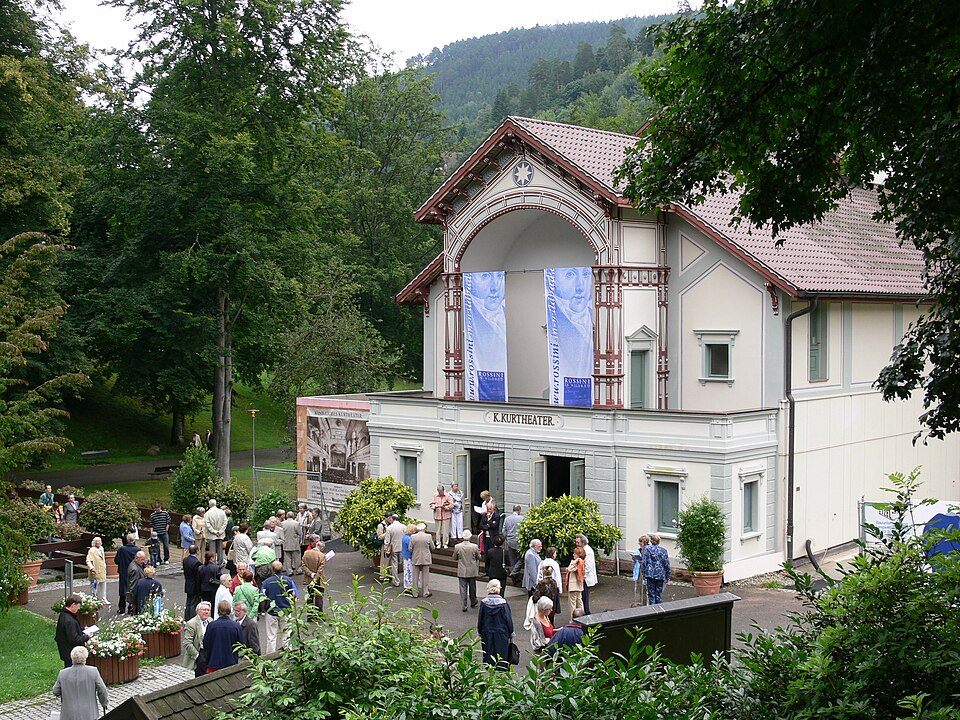
Rossini in Wildbad is an annual bel canto opera festival in Bad Wildbad, Baden-Württemberg, Germany, specialising in the lesser-known operas of Gioachino Rossini and his contemporaries. The festival, which commemorates Rossini's stay at the spa town in 1856, was founded in 1989 by a group of people interested in restoring and reviving the spa facilities, especially the theatre. Usually held in June and July, it features also compositions of other composers from the bel canto period. Performances are held at various historic spa facilities including the former Royal spa theatre and the König-Karls-Bad, in or near the spa park. Many productions have been recorded.
History
Gioachino Rossini, a prolific composer of Italian opera, stayed at Wildbad and used its spa for several weeks in 1856, which apparently invigorated him enough to start composing again. His wife Olympe Pélissier is said to have recommended the place because its water was very mild. Early in his career, until age 37, he had composed operas, many masterpieces that remained in the repertoire, but also operas that were neglected. After a hiatus of decades, he began to compose again after the spa visit, on German paper. He would later call his late compositions his "sins of old age" (Péchés de vieillesse).
The Rossini in Wildbad festival was founded in 1989 on an initiative of Margarete Bott. She and others wanted to see the Königliches Kurtheater (Royal spa theatre), restored and used again. She collaborated with the conductor Wilhelm Keitel as artistic director and the cultural manager Rüdiger Krüger responsible for organisation and management.
Jochen Schönleber became artistic director in 1992 and has been Intendant since 2000. Antonino Fogliani, an Italian conductor focused on Rossini, first worked at the festival in 2004 and was appointed music director in 2011.
1989–1992: Wilhelm Keitel, Rüdiger Krüger
from 1992: Jochen Schönleber (artistic director, from 2000 Intendant)
2011–2026: Antonino Fogliani (music director)
Theme
The festival is focused on the complete operas by Rossini, both his well-known operas and the neglected repertoire. It also features compositions of other composers from the bel canto period, as well as different setting of librettos that Rossini used. Many festival productions have been broadcast and recorded on CD or DVD, in collaboration with labels Naxos and Bongiovanni. The festival works with young singers and has a regular orchestra, Virtuosi Brunensis, from Brno.
Venues
The first opera performances were held at the Kurhaus, while the theatre was restored. From 2010 the main venue for opera performances and recordings was the Neue Trinkhalle, the hall where spa guests used to drink the mineral water. It seats 500 people. The Kurhaus venue was then used for rehearsals and concerts; the last scenic production at the Kurhaus was La gazza ladra in 2009.
The Königliches Kurtheater, reopened in 2014, seats 250. Another venue, Forum König-Karls-Bad, is in the König-Karls-Bad, formerly a bathing house called Haus des Gastes, now a conference centre. The festival also uses several open air locations for events. In 2026, the Kurhaus again became a festival venue.
All venues are in or near the Kurpark. It is connected to Pforzheim, the closest city, via the Enz Valley Railway which is part of the Stadtbahn Karlsruhe net. The starting times of performances are planned with respect to the tram's time table.
Academy
An academy was founded in 2004, named Akademie BelCanto, in order to train young singers in the art of bel canto. Schönleber has been its director, and instructors have included Alberto Zedda and Kurt Widmer as well as Joyce DiDonato when she made a recording of La Cenerentola with the SWR Rundfunkorchester Kaiserslautern. Singers who were students of the academy include Michael Spyres, Olga Peretyatko, Diana Haller and Marina Viotti.