
REFERENCE Wikipedia, read on Browse · 4 min read
Marcel Aymé
French writer (1902–1967)
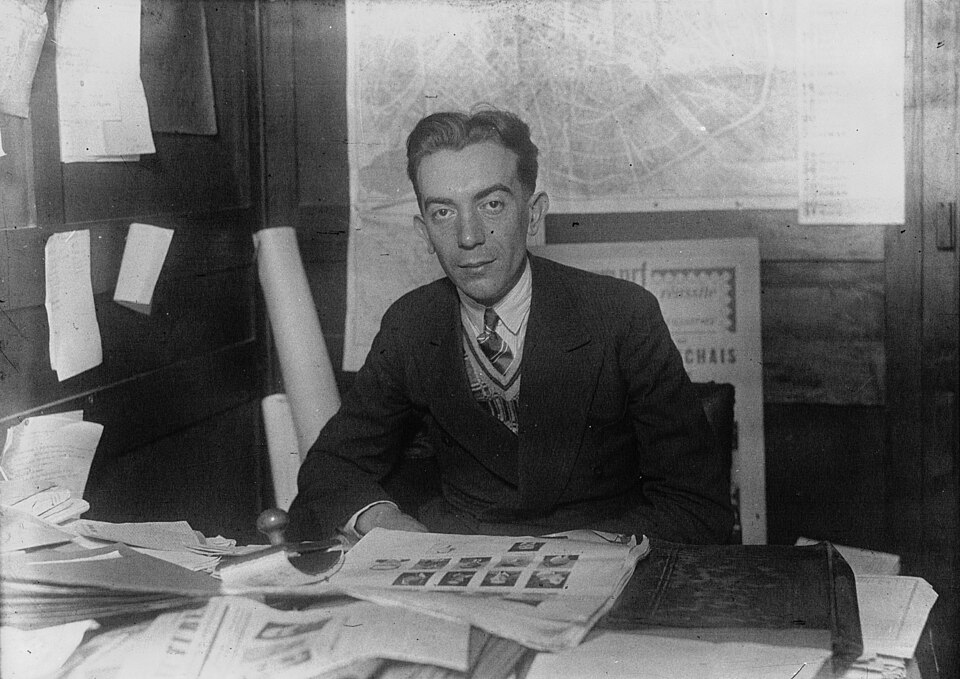
Marcel Aymé (French pronunciation: [maʁsɛl ɛme]; 29 March 1902 – 14 October 1967) was a French novelist and playwright, who also wrote screenplays and works for children.
Biography
Marcel André Aymé was born in Joigny, in the Burgundy region of France, the youngest of six children. His father, Joseph, was a blacksmith, and his mother, Emma Monamy, died when he was two years old, after the family had moved to Tours. Marcel was sent to live with his maternal grandparents in the village of Villers-Robert, a place where he would spend the next eight years, and which would serve as the model for the fictitious village of Claquebue in what is perhaps the most well-known of his novels, La Jument verte. In 1906 Marcel entered the local primary school. Because his grandfather was a staunch anti-clerical republican, he was looked down upon by his classmates, many of whose parents held more traditional views. Accordingly, Marcel was not baptized before reaching the age of eight, nearly two years after the death of his grandfather in 1908. Orphaned once more when his grandmother died two years later, he briefly lived with other family members before moving to Dole, a small town of the Franche-Comte region, to stay with an aunt and attend the Collège de l'Arc, where he demonstrated more ability in mathematics than in literature. His years at school there were an unpleasant experience he would never look back on fondly.
Despite ongoing issues with his health that had begun when he was a child, Aymé was able to perform his military service, which began in 1919, as part of an artillery unit in the occupied Rhineland. In 1923 he moved to Paris where he worked unsuccessfully at a bank, an insurance company, and as a journalist. Though he failed in his career as a reporter, his stint at the newspaper allowed him to discover his love of writing.
His first published novel was Brûlebois (1926), and in 1929 his La Table aux crevés won the Prix Renaudot. After the great success of his novel La Jument verte (1933), translated into English as The Green Mare, he concentrated mostly on writing and publishing children's stories, novels, and collections of stories. In 1935 he also started writing movie scripts. In theatre, Marcel Aymé found success with his plays Lucienne et le boucher, Clérambard (1949), a farce, and Tête des autres (1952), which criticized the death penalty.He died in 1967 and was buried in the Cimetière Saint-Vincent in the Montmartre Quarter of Paris.
Work
One of Aymé's most famous short stories is Le passe-muraille or "The Walker-Through-Walls". At the age of 43, Dutilleul suddenly discovers that he has "the remarkable gift of being able to pass through walls with perfect ease". What begins as a novelty that gives him pleasure ends up pushing Dutilleul toward ever more sinister pursuits.
Legacy
Visitors to Paris can see a monument in his honour at Place Marcel-Aymé, in the Montmartre Quarter. The statue is based on his short story "Le passe-muraille" ("The Walker through Walls").
Filmography
Street Without a Name, directed by Pierre Chenal (1934, based on the novel La Rue sans nom)
Mr. Peek-a-Boo, directed by Jean Boyer (1951, based on the short story The passer-through-walls)
The Beautiful Image, directed by Claude Heymann (1951, based on the novel La Belle image)
La Table aux crevés, directed by Henri Verneuil (1951, based on the novel The Hollow Field)
La Traversée de Paris, directed by Claude Autant-Lara (1956, based on the short story Traversée de Paris)
Way of Youth, directed by Michel Boisrond (1959, based on the novel Le Chemin des écoliers)
The Man Who Walked Through the Wall, directed by Ladislao Vajda (West Germany, 1959, based on the short story The passer-through-walls)
The Green Mare, directed by Claude Autant-Lara (1959, based on the novel The Green Mare)
Le Nain, directed by Pierre Badel (1961, TV film, based on the short story Le Nain)
La Bonne Peinture, directed by Philippe Agostini (1967, TV film, based on the short story La Bonne Peinture)
Le Boeuf clandestin, directed by Jacques Pierre (1969, TV film, based on the novel Le Boeuf clandestin)
Clérambard, directed by Yves Robert (1969, based on the play Clérambard)
Vogue la galère, directed by Raymond Rouleau (1973, based on the play Vogue la galère)
Le Passe-muraille, directed by Pierre Tchernia (1977, TV film, based on the short story The passer-through-walls)
La Grâce, directed by Pierre Tchernia (1979, TV film, based on the short story La Grâce)
La Vouivre, directed by Georges Wilson (1989, based on the novel La Vouivre)
Uranus, directed by Claude Berri (1990, based on the novel Uranus)
Les Bottes de sept lieues, directed by Hervé Baslé (1990, TV film, based on the short story Les Bottes de sept lieues)
L'Huissier, directed by Pierre Tchernia (1991, TV film, based on the short story L'Huissier)
The Favour, the Watch and the Very Big Fish, directed by Ben Lewin (1991, based on the short story Rue Saint-Sulpice)
Les jours où je n'existe pas, directed by Jean-Charles Fitoussi (2002, based on the short story Le Temps mort)
Le Boeuf clandestin, directed by Gérard Jourd'hui (2013, TV film, based on the novel Le Boeuf clandestin)
Le Passe-muraille, directed by Dante Desarthe (2016, TV film, based on the short story The passer-through-walls)