
REFERENCE Wikipedia, read on Browse · 7 min read
Giovanni Paolo Panini
Italian painter and architect (1691–1765)
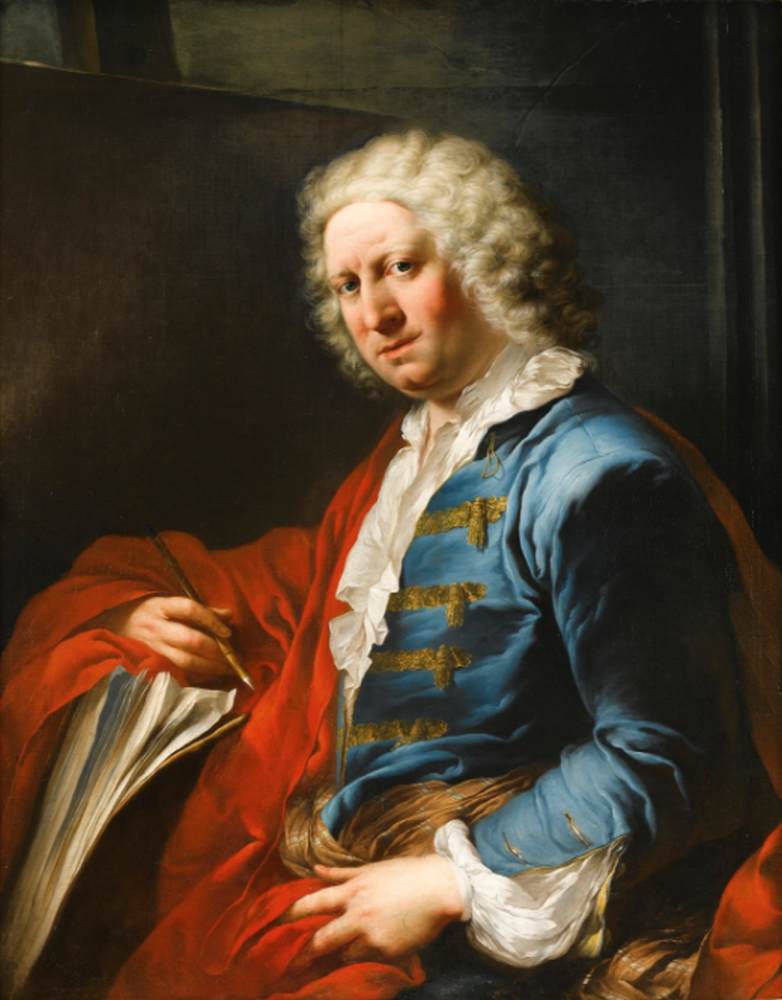
Giovanni Paolo, also known as Gian Paolo Panini or Pannini (17 June 1691 – 21 October 1765), was an Italian Baroque painter and architect who worked in Rome and is primarily known as one of the vedutisti ("view painters"). As a painter, Panini is best known for his vistas of Rome, in which he took a particular interest in the city's antiquities. Among his most famous works are his view of the interior of the Pantheon (on behalf of Francesco Algarotti), and his vedute – paintings of picture galleries containing views of Rome. Most of his works, especially those of ruins, have a fanciful and unreal embellishment characteristic of capriccio themes. In this they resemble the capricci of Marco Ricci. Panini also painted portraits, including one of Pope Benedict XIV.
Biography
Early life and training
Giovanni Paolo Panini was born in Piacenza on 17 June 1691. As a young man, he trained in his native town, under Giuseppe Natali and Andrea Galluzzi, and with stage designer Francesco Galli Bibiena. A book of drawings dated 1708 (Piacenza, Biblioteca Passerini-Landi) probably belongs to this period of his training. In 1711, he moved to Rome, where he studied drawing with Benedetto Luti and took lessons in landscape painting from Andrea Locatelli. His first signed work is a canvas depicting the Flight into Egypt (Genoa, priv. col.), which is influenced by Flemish landscape painting, particularly the work of the brothers Pieter and Jan Frans van Bloemen, and of the Dutch vedutista Caspar van Wittel.
In Rome, Panini earned a name for himself as a decorator of palaces. His earliest commissions came from Cardinal Giambattista Patrizi and from Elisabeth Farnese, who, in 1714, had become the second wife of Philip V of Spain. Their patronage, together with the high quality of his work,quickly spread Panini's fame in Italy and abroad. In 1719, Panini was admitted to the Accademia dei Virtuosi al Pantheon. That same year, he was became a member of the Accademia di San Luca, Rome's oldest and most distinguished academy of art. Panini taught perspective at the Accademia for several years and was elected its principe (director) in 1754.
In 1720 he was commissioned to decorate the Palazzo de Carolis, and between 1721 and 1722 he was decorating the Seminario Romano for Cardinal Giovanni Battista Spínola. In 1722 he received an important commission from Pope Innocent XIII: the decoration of the mezzanine apartment in the Quirinal Palace. A few sections survive, depicting views of villas and gardens against a background of sky and seen through imitation balustrades. The perspective view that he frescoed in 1722 in the courtyard of the Palazzo Patrizi, near San Luigi dei Francesi, is lost, but the decoration of the library of the Santa Croce in Gerusalemme Monastery in Rome (completed by 1724 ) survives. From 1725 to 1726 Panini was painting frescoes (detached; Palazzo Madama, Rome) in the Galleria Nobile and the Galleriola of the Palazzo Alberoni. To this same period dates the fresco cycle of the Villa Montalto Grazioli in Frascati: a complex decoration, framed by simulated pilasters and columns and depicting circular spaces, fake statuary and allegorical figures of Continents, Seasons and Planets. The decoration of the mirrors in a room of the Palazzo Sciarra is also attributed to Panini.
In 1724 he married Miss Gossert, sister-in-law of Nicolas Vleughels, director of the French Academy in Rome, with whom he had two sons: the architect Giuseppe (1720‒1812), and the painter Francesco (1745‒1812), who collaborated with their father and were deeply influenced by his art. The fact that in 1732 Panini was accepted as a member of the French Academy in Rome and assigned to teaching optics testifies to the extent of his fame by this time.
Work as an easel painter
Following in the footsteps of Caspar van Wittel, Giovanni Ghisolfi and Salvator Rosa, Panini devoted himself to the painting of vedute and capriccios. Noteworthy among his capriccios are the Architectural Capriccio (Toronto, Art Gallery of Ontario), and Alexander Cutting the Gordian Knot (Baltimore, MD, Walters Art Museum). In these works the compositions are vertical, animated by crowds of figures and lit by a brilliant light. Perhaps the most famous of Panini's capriccios is the Roman Capriccio: The Pantheon and Other Monuments (1735; he Indianapolis Museum of Art), which features a staggering array of Roman monuments, including the Temple of Hadrian, the Pantheon, the Temple of Vesta, the Maison Carrée and the Theatre of Marcellus. While quite cavalier with regard to geography, Panini was remarkably faithful in his architectural reconstructions. He carefully edited out later additions to the original buildings, such as the walled-in sections in the arches of the Theatre of Marcellus and Bernini's bell towers on the Pantheon's pediment.
Besides his capriccios, Panini also painted realistic topographical views of Rome. Heavily in demand among contemporary tourists, they include views of the ruined monuments of ancient Rome, such as the Colosseum, the Arch of Constantine and Other Monuments (1735; Gemäldegalerie, Berlin) or the signed and dated View of the Forum (1735; Detroit Institute of Arts). There are also views of contemporary Rome, such as the Basilica of Santa Maria Maggiore (signed and dated 1742 ) or the Piazza del Quirinale (signed and dated 1733 but executed in 1742; both Rome, Quirinal Palace), works teeming with crowds of vivacious little figures.
Another type of veduta shows the interiors of buildings, antique and modern, such as the Interior of St. Peter's Basilica, which exists in numerous versions, including one signed and dated 1731 (Saint Louis Art Museum), or the rare view of the Interior of San Giovanni in Laterano (Moscow, Pushkin Museum). Some vedute represent public ceremonies or the visit of some important figure to the city, as in the View with Firework Machine to Celebrate the Birth of the Infanta of Spain, signed and dated 23 October 1727 (London, Victoria and Albert Museum) or the two signed paintings commissioned by Cardinal Melchior de Polignac, French ambassador to the Holy See: the Preparation of the Decorations and Fireworks in Piazza Navona for the Celebration of the Birth of the Dauphin (1729) and Cardinal Melchior de Polignac Visiting St. Peter’s ( 1730; both Paris, Louvre). The former painting depicts the decorative wood and papier-mâché arches and the preparations being made for the firework display held on 30 November 1729 to celebrate the birth of Louis XV’s son, Louis Ferdinand. The monumental scene is crowded with figures and is rendered highly theatrical by its luminous composition centred around the imposing façade of Sant'Agnese in Agone, flanked by an imaginary view of Cardinal de Polignac’s palazzo. In the 1740s Panini recorded the visit to Rome of the Bourbon monarch, Charles III of Spain, with two paintings: the Visit of Charles III to St. Peter's Basilica (1745) and Charles of Bourbon Visiting Pope Benedict XIV at the Coffee House del Quirinale (1746; both Naples, Museo di Capodimonte). Dating to 1747 is the large canvas Musical Feast Given by the Cardinal de La Rochefoucauld for the Marriage of the Dauphin, which depicts the musical feast held at the Teatro Argentina in Rome by the Cardinal de La Rochefoucauld in honour of the marriage of the Dauphin Louis to Maria Josepha of Saxony (Paris, Louvre).
Among Panini's most appreciated works are his pictures of vast imaginary galleries, the walls of which are entirely stacked with vedute depicting the most famous Roman buildings, statues and reliefs (e.g. Modern Rome, 1757; New York, Metropolitan Museum of Art). Such compositions provided European tourists with a handy souvenir of all the most characteristic sights of Rome. The Gallery of Views of Ancient Rome (1758) and the Gallery of Views of Modern Rome (1759; both Paris, Louvre) were commissioned by Claude-François de Montboissier de Canillac de Beaufort, a friend and patron of Panini. Panini died in Rome on 21 October 1765 and was buried in the small church of San Giovanni in Ayno in the rione Regola.
Panini, who in 1732 was one of a panel of judges for the competition to design the façade of San Giovanni in Laterano, is also documented as an architect. In 1734 he designed the chapel of Santa Teresa (inaugurated 1745) in Santa Maria della Scala in Rome. He also provided drawings of designs for carvings and ecclesiastical furnishings, such as those for the tabernacle of the church of San Romualdo in Ravenna. Panini also created firework machines and ephemeral architectural sets for various celebrations for the Cardinal-Protectors of France and Spain.
Legacy
Panini’s studio was a major artistic hub that trained and influenced both Italian and foreign artists. His style influenced other vedutisti, such as his pupils Hubert Robert and Charles-Louis Clérisseau, as well as Canaletto, Bernardo Bellotto, and Claude-Joseph Vernet. Some British landscape painters, such as Marlow, Skelton and Wright of Derby, also imitated his capricci.
In addition to being a painter and architect, Panini was a professor of perspective and optics at the French Academy of Rome. His masterful use of perspective was later the inspiration for the creation of the "Panini Projection", a mathematical rule for constructing images with very wide fields of view, which is now used in software for creating and viewing panoramic photographs.
Panini was one of the most successful Roman painters of his time. The Spanish monarchs valued his work so highly that they commissioned Filippo Juvarra to purchase paintings by Panini to decorate the Lacquer Room of the Royal Palace of La Granja de San Ildefonso. When still a Prince, Charles IV of Spain bought several of Panini's works, which are still preserved in the Museo del Prado and the royal palaces.
Panini's works are held in the permanent collections of many museums worldwide, including the Prado Museum, the Louvre, the Museo Nazionale di Capodimonte, the Museo Thyssen-Bornemisza, the Hermitage, the Pushkin Museum, the Staatsgalerie Stuttgart, the Staatliche Museen, the Palazzo del Quirinale, the Toledo Museum of Art, the University of Michigan Museum of Art, the Brooklyn Museum, the Saint Louis Art Museum, the Detroit Institute of Arts, the Museum of Fine Arts Boston, the Getty Center, the Metropolitan Museum of Art, the Nelson-Atkins Museum of Art, the Virginia Museum of Fine Arts, the Walters Art Museum, the Harvard Art Museums, the Philadelphia Museum of Art, and the Indianapolis Museum of Art.