
REFERENCE Wikipedia, read on Browse · 19 min read
Edith Stein
German nun and philosopher (1891–1942)
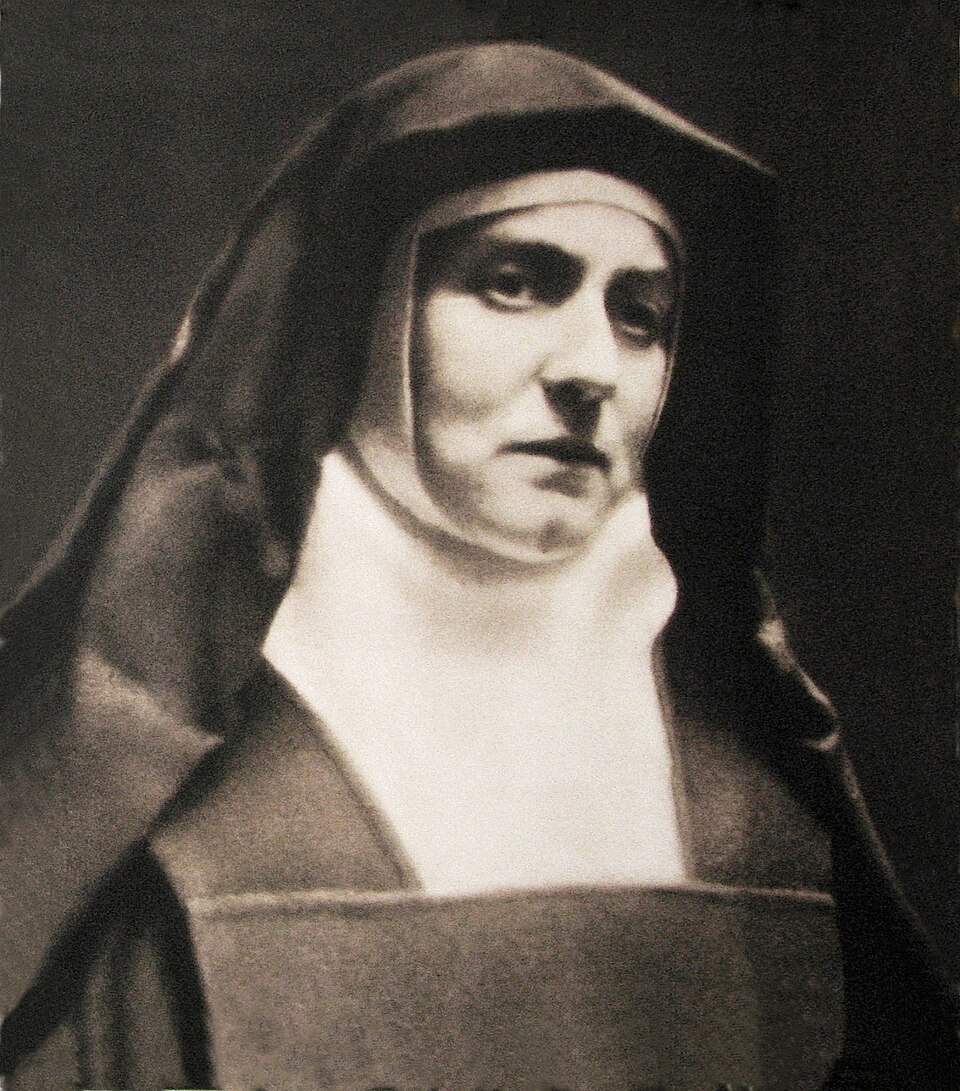
Edith Stein (German: [ʃtaɪn]; religious name Teresa Benedicta of the Cross; 12 October 1891 – 9 August 1942) was a German philosopher who converted to Catholicism and became a Discalced Carmelite. She was murdered in the gas chamber at the Auschwitz II-Birkenau concentration camp on 9 August 1942, and is canonized as a martyr of the Catholic Church; she is also one of six patron saints of Europe.
Stein was born into an observant German Jewish family, but had become an agnostic by her teenage years. After World War I broke out, she trained as a nursing assistant and worked in an Austro-Hungarian field hospital in 1915. After completing her doctoral thesis at the University of Freiburg in 1916, she obtained an assistantship to Edmund Husserl there.
From reading the life of the reformer of the Carmelites, Teresa of Ávila, Stein was drawn to the Christian faith. She was baptized on 1 January 1922 into the Catholic Church. At that point, she wanted to become a Discalced Carmelite nun but was dissuaded by her spiritual mentor, the archabbot of Beuron, Raphael Walzer OSB. She then taught at a Jewish school of education in Speyer. As a result of the requirement of an "Aryan certificate" for civil servants promulgated by the Nazi government in April 1933 as part of its Law for the Restoration of the Professional Civil Service, she had to quit her teaching position.
Edith Stein was admitted as a student to the study of religion to the Discalced Carmelite monastery in Cologne on 25 November, on the first vespers of the feast of Saint Teresa of Ávila, and received the religious habit as a novice in April 1934, taking the religious name Teresia Benedicta a Cruce (Teresia in remembrance of Teresa of Ávila, Benedicta in honour of Benedict of Nursia). She made her temporary vows on 21 April 1935, and her perpetual vows on 21 April 1938.
The same year, Teresa Benedicta a Cruce and her biological sister Rosa, by then also a convert and an extern (tertiary of the order, who would handle the community's needs outside the monastery), were sent to the Carmelite monastery in Echt, Netherlands, for their safety. In response to the pastoral letter from the Dutch bishops on 26 July 1942, in which they made the treatment of the Jews by the Nazis a central theme, all baptized Catholics of Jewish origin (according to police reports, 244 people) were arrested by the Gestapo on the following Sunday, 2 August 1942. They were sent to the Auschwitz concentration camp, and were murdered in the Birkenau gas chambers on 9 August 1942. Stein was beatified in 1987 and canonized in 1998 by Pope John Paul II.
Early life
Edith Stein was born into a Jewish family on October 21, 1891, the Jewish holy day of Yom Kippur, in Breslau (now Wrocław, Poland), Lower Silesia, which was then part of the German Empire. She was the youngest of 11 children, seven of whom lived to adulthood. Her parents were Siegfried and Auguste Stein, who ran a lumber business. Siegfried died of sunstroke before Edith's second birthday; Auguste successfully continued the business. Though Auguste was devout and encouraged her children to observe the Jewish holidays, Edith appears to have received minimal religious training in Judaism.
Stein entered the Viktoriaschule, a girl's school in Breslau, when she was six. In 1906, she completed her secondary education at fourteen, leaving school for a year to live with an older sister and brother-in-law in Hamburg. They were not religious, and Stein began distancing herself from personal religious practice. After she returned to Breslau, she entered the Gymnasium to prepare for university studies. She graduated in March 1911; her performance on the written exams was so good that she did not have to take the oral exams..
Academic career
Breslau, 1911–1913
In April 1911, Stein entered the Schlesische Friedrich-Wilhelms-Universität (Silesian Friedrich Wilhelm University) in Breslau, with interests in psychology, history, and German studies. In her first semester, she attended a course in natural philosophy taught by Richard Hönigswald. Thoughout her stay at the university from 1911 to 1912, she studied psychology with William Stern, who became her initial choice as a dissertation advisor. Stern influenced Stein to join the "Pedagogical Group" he sponsored, an active student group that explored how to improve the education of future teachers. Stein later stated that her association with this group was one of the most important aspects of her academic life in Breslau.
While taking a seminar on the study of thought that was associated with the Würzburg School of psychology during late 1911, she encountered many references to the work of the philosopher Edmund Husserl, had written the Logische Untersuchungen (Logical Investigations) and worked at the University of Göttingen Stein then saw a letter to her mother from a cousin who had recently moved to Göttingen, inviting Stein to study there. The day after seeing the letter, Stein informed her family she was going to study in Göttingen for the following summer, intending to return to complete her studies. In the meantime, she read the second volume of Logical Investigations during the Christmas break, becoming familiar with Husserl's philosophy of phenomenology. Before leaving Breslau, she asked Stern to be her dissertation advisor; he proposed she study the development of children's thoughts. En route to Göttingen, she stopped at the Institute of Applied Psychology near Potsdam to meet with Otto Lipmann, one of Stern's collaborators.
Göttingen, 1913–1915
Summer 1913
Stein, who was 21 years old, arrived at the University of Göttingen in April 1913 to study for the summer semester. The day after her arrival, she introduced herself to Adolf Reinach, who was a privatdozent in philosophy; he helped Stein get into Husserl's summer seminar, which was influenced by his newly published work, Ideen I [Ideas I]. In this work, he aimed to build a critique of naturalism and objectivity that would replace psychology's claim as an objective science studying subjectivity with a more rigorous transcendental science of subjectivity.
She also took a history seminar with Max Lehmann studying the Constitution of the German Empire; he suggested that her paper analyzing the party programs of the 1849 Frankfurt Constitution be submitted as a thesis for a state board examination that was required to obtain a degree. She joined The Philosophical Society, a group of Husserl's students who met once a week,
and attended unofficial lectures by Max Scheler that were sponsored by the society. These lectures were given in hotels or cafes because Scheler had been prohibited from teaching at the university because of personal indiscretions. Scheler had just published a work examining the feeling of sympathy from a phenomenological perspective. Despite reservations about Scheler's behavior, Stein later noted that his lectures played an early role in the transformation of her faith by introducing her to Catholic ideas. His influence also played a major role in her thinking about the concept of empathy. By the end of the summer, she had decided to obtain her dissertation in philosophy under Husserl. He agreed, and she chose empathy as her dissertation topic. She sent a note to Stern informing him that she would not be continuing with psychology.
October 1913–January 1915
Stein briefly returned to Breslau after the summer, then resumed her studies at Gottingen starting in the 1913–1914 winter semester. She become closer to Reinach, whose mentorship guided her understanding of phenomenology; strengthened relationships with fellow phenomenology students, including Hans Lipps and Roman Ingarden; and met Jean Héring who came to take his state exams. Stein focused on her dissertation, particularly studying how the phenomenological approach to empathy differed from the perspective of Theodore Lipps, the major theorist of empathy at the time., and she continued preparing for the state exams. At times, she would feel despair and suicidal ideation, but Reinach's support buoyed her.
At the end of July 1914, classes were cancelled when Germany declared a state of war in the prelude to World War I. In support of the German war effort, Stein returned to Breslau and immediately registered for a nursing course to serve in the Red Cross. She was not immediately called up after her training, which gave her a chance to return to Göttingen and complete her state examinations, earning highest honors in January 1915. During this time she served as the vocational counselor for women students, a position that had been established by the Frauenbildung-Frauenstudium Verein [Society for Women's Education- Women's Studies]
Red Cross Service, April–September 1915
When Stein returned to Breslau after completing her state examinations, she was called up for service, agreeing to work in a field hospital for the Austro-Hungarian Army. She was assigned to a military reserve hospital in Mährisch Weißkirchen, arriving in early April 1915. She was initially assigned to the typhus ward, transferring to an operating room after three months. She was furloughed after six months. She earned a Medal of Valor for her service and dedication. She expected to return to the hospital, but it was closed when the military front shifted east toward Russia.
Her service in an Austro-Hungarian hospital exposed her to an ethnically and linguistically diverse environment. Though the nurses and aids were German, the hospital was under Czech oversight: It was led by a Czech director and mainly staffed by Czech and Polish doctors. The patients were from the various nationalities of the empire, as well as Russians, Turks and Romani. Stein frequently relied on a nine-language manual to communicate with the people she served.
Breslau, September 1915–July 1916
For the remainder of 1915, Stein worked on her dissertation. During Christmas, she went to in Göttingen to visit Reinach, who was on leave after he had volunteered to serve in the German Army, and his wife Anna. She also met with Husserl to discuss her Red Cross service in his native Moravia and his continuing role as her doctoral advisor. She returned to Breslau. She taught Latin, German, history, and geography at the Realgymnasum of the Victoriaschule while completing her dissertation. She completed it during the 1916 Easter break and sent it to Husserl, who had recently moved to a more prestigious position at the University of Freiburg.
Freiburg, 1916–1918
In July 1916, Stein traveled to the University of Freiburg during the during the Victoriaschule's summer break to take her oral examination for the doctorate. When she arrived, she discovered that Husserl had not yet read her dissertation. With prodding from Husserl's wife, Malvine, he agreed to do so. Stein set the oral examinations for August 3, so she return to her teaching in Breslau before the break was over. Meanwhile, Stein attended Husserl's summer seminar and met Martin Heidegger at one of the Husserls' social events.
Before the examination, Husserl praised her dissertation, encouraging her to propose being his literary assistant and collaborator. Husserl accepted. Stein completed her oral exams and was awarded a PhD, summa cum laude. She would publish three of the seven chapters of her dissertation in the following year under the title Zum Problem der Einfühlung [On the Problem of Empathy]. After completing her examinations, Stein returned to Breslau. She was released from her teaching duties at the end of September.
Stein then became a member of the faculty at Freiburg, where she worked until 1918 as a teaching assistant to Husserl, who had transferred to that institution. The University of Göttingen rejected her habilitation thesis in 1919. Although Stein passed her doctoral examination with distinction, her attempts to habilitate failed due to the fact that Stein was a woman.
Her rejected habilitation thesis, Beiträge zur philosophischen Begründung der Psychologie und der Geisteswissenschaften (Contributions to the Philosophical Foundations of Psychology and the Human Sciences), was published in the Jahrbuch für Philosophie und phänomenologische Forschung in 1922. She is categorized as a realistic phenomenologist.
Conversion to Catholicism
While Stein had earlier contacts with Catholicism, it was her reading of the autobiography of the mystic Teresa of Ávila during summer holidays in Bad Bergzabern in 1921 that prompted her conversion and eventually the desire to seek the life of a Discalced Carmelite. Baptized on 1 January 1922, and dissuaded by her spiritual advisers from immediately seeking entry to the enclosed and hidden life of a Carmelite nun, Stein obtained a position to teach at the Dominican school of Saint Magdalena in Speyer from 1923 to 1931. While there, Stein translated Thomas Aquinas' De Veritate (Of Truth) into German, familiarized herself with Catholic philosophy in general and tried to bridge the phenomenology of her former teacher, Husserl, to Thomism. She visited Husserl and Heidegger at Freiburg in April 1929, the same month that Heidegger gave a speech to Husserl on his 70th birthday. In 1932 she became a lecturer at the Catholic Church-affiliated Institute for Scientific Pedagogy in Münster, but antisemitic legislation passed by the Nazi government forced her to resign the post in 1933. In a letter to Pope Pius XI, she denounced the Nazi regime and asked the Pope to openly denounce the regime "to put a stop to this abuse of Christ's name".
As a child of the Jewish people who, by the grace of God, for the past eleven years has also been a child of the Catholic Church, I dare to speak to the Father of Christianity about that which oppresses millions of Germans. For weeks we have seen deeds perpetrated in Germany which mock any sense of justice and humanity, not to mention love of neighbor. For years the leaders of National Socialism have been preaching hatred of the Jews ... But the responsibility must fall, after all, on those who brought them to this point and it also falls on those who keep silent in the face of such happenings.
Everything that happened and continues to happen on a daily basis originates with a government that calls itself 'Christian'. For weeks not only Jews but also thousands of faithful Catholics in Germany, and, I believe, all over the world, have been waiting and hoping for the Church of Christ to raise its voice to put a stop to this abuse of Christ's name. Is not this idolization of race and governmental power which is being pounded into the public consciousness by the radio open heresy? Isn't the effort to destroy Jewish blood an abuse of the holiest humanity of our Savior, of the most blessed Virgin and the apostles? Is not all this diametrically opposed to the conduct of our Lord and Savior, who, even on the cross, still prayed for his persecutors? And isn't this a black mark on the record of this Holy Year which was intended to be a year of peace and reconciliation? We all, who are faithful children of the Church and who see the conditions in Germany with open eyes, fear the worst for the prestige of the Church, if the silence continues any longer.
Her letter received no answer, and it is not known for certain whether the Pope ever saw it. However, in 1937 the Pope issued an encyclical written in German, Mit brennender Sorge (according to its German first words, lit. "With deep anxiety"), in which he criticized Nazism, listed violations of the Concordat between Germany and the Church of 1933, and condemned antisemitism.
Discalced Carmelite and martyr
Although Edith Stein spent eight years with the Dominicans in Speyer as a teacher and considered the Benedictine Abbey of Beuron, according to her own words, "like the antechamber of heaven", she never thought to become a Dominican or a Benedictine: "It always seemed to me as if the Lord had reserved something for me in Carmel that I could only find there". Stein entered the Discalced Carmelite monastery St. Maria vom Frieden ("Our Lady of Peace") in Cologne-Lindenthal in October 1933 and took the religious name Teresia Benedicta a Cruce ("Teresa Benedicta of the Cross"). In Cologne she wrote her metaphysical book Endliches und ewiges Sein (Finite and Eternal Being), which attempted to combine the philosophies of Thomas Aquinas, Duns Scotus and Husserl.
To avoid the growing Nazi threat, the order transferred Edith and her sister, Rosa, who was also a convert and an extern sister of the Carmel, to the Discalced Carmelite monastery in Echt, Netherlands. There she wrote Studie über Joannes a Cruce: Kreuzeswissenschaft ("Studies on John of the Cross: The Science of the Cross"). In her testament of 9 June 1939 she wrote: I beg the Lord to take my life and my death … for all concerns of the sacred hearts of Jesus and Mary and the holy church, especially for the preservation of our holy order, in particular the Carmelite monasteries of Cologne and Echt, as atonement for the unbelief of the Jewish People, and that the Lord will be received by his own people and his kingdom shall come in glory, for the salvation of Germany and the peace of the world, at last for my loved ones, living or dead, and for all God gave to me: that none of them shall go astray.
Stein's move to Echt prompted her to be more devout and even more observant of the Carmelite rule. After having her teaching position revoked by the implementation of the Law for the Restoration of the Professional Civil Service, Stein quickly eased back into the role of instructor at the convent in Echt, teaching both fellow sisters and students within the community Latin and philosophy.
Even prior to the Nazi occupation of the Netherlands, Stein believed that she would not survive the war, going so far as to write to the prioress to request her permission to "allow [Stein] to offer [her]self to the heart of Jesus as a sacrifice of atonement for true peace" and she also wrote a will. Her fellow sisters would later recount how Stein began "quietly training herself for life in a concentration camp, by enduring cold and hunger" after the Nazi invasion of the Netherlands in May 1940.
Ultimately, she would not be safe in the Netherlands. The Dutch Bishops' Conference had a public statement condemning Nazi racism read in all churches across the nation on 20 July 1942. In a retaliatory response on 26 July 1942 the Reichskommissar of the Netherlands, Arthur Seyss-Inquart, ordered the arrest of all Jewish converts who had previously been spared. Along with two hundred and forty-three baptized Jews who were living in the Netherlands, Teresa Benedicta a Cruce was arrested by the SS on 2 August 1942. She and her sister Rosa were imprisoned at the concentration camps of Amersfoort and Westerbork before they were deported to Auschwitz. A Dutch official at Westerbork was so impressed by her sense of faith and her calm disposition, so he offered her an escape plan. Stein vehemently refused his assistance, stating: "If somebody intervened at this point and took away [her] chance to share in the fate of [her] brothers and sisters, that would be utter annihilation."
On 7 August 1942, early in the morning, 987 Jews were deported to the Auschwitz concentration camp. It was probably on 9 August that Teresa Benedicta of the Cross, her sister Rosa, and many more Jewish people were killed in a gas chamber at Birkenau.
Philosophy
Stein's development as a philosopher is frequently divided into three periods: an early, phenomenological (1916–1925), a middle, comparative (1925–1933) and a late, Christian (1935–1942). In reality the same factors work themselves out throughout her work and propels it forward: 1. a profound understanding of and commitment to the phenomenological method as taught by Husserl and Reinach; 2. a deep sense of responsibility to the other for what we believe and 3. an acceptance of my own inability to form a complete, meaningful worldview without divine assistance. The three periods are best understood as stages of integration of these three factors, with Stein's baptism New Year's Day 1922, marking a decisive step on the way and her entering Carmel 14 October 1933 marking another.
The early phenomenological period (1916–1925)
Stein's dissertation on empathy was according to her own account an attempt to fill a gap in Husserl's work. In her autobiographical Life in a Jewish Family, she recalled that he took empathy to be the crucial act in which intersubjectivity was established, but nowhere detailed exactly what was meant by it. She therefore wanted to undertake this task and thereby clarify this crucial idea for the development of the phenomenological movement. While working as Husserl's assistant (1916–18) she edited Husserl's manuscripts of what was later to be published as Ideas II and III, and in the process came to understand the extraordinary importance this act has for our constitution of the intersubjective world, and in particular for the objects studied by psychology and the humanities. When she resigned from her position as Husserl's assistant, the first work she undertook was on the phenomenological constitution of those objects: the psyche and the spirit. The result was the two treatises of Philosophy of Psychology and the Humanities, published in Husserl's Jahrbuch 1922: Psychic Causality and Individual and Community. From this period also dates Introduction to Philosophy, An Investigation Concerning the State, and very importantly Freedom and Grace.
The middle comparative period (1925–1933)
Encouraged to study and compare Thomas Aquinas' philosophy with that of the phenomenological movement, Stein embarked on a translation project of Aquinas' De Veritate, which was to be published in two volumes in 1932. The work, which translates Aquinas' way of thinking into a modern German idiom and restyles it as a contemporary academic treatise, occasioned that Stein engaged with Aquinas' thought as a phenomenologist, i.e. as someone interested in the matters discussed by Aquinas, as distinct from providing an interpretation of Aquinas' thought or writing in prolongation of it as a thomist. The most important works from this period are 'Husserl and Aquinas: A Comparison', in which she discusses the differing methodologies of Husserl and Aquinas and accounts for their differences, Potency and Act, in which she attempts a phenomenological investigation of 'potency' and 'act' and the twin work of anthropology: The Structure of the Human Person. Philosophical Anthropology and What is the Human Being? Theological Anthropology (the second volume remains a highly developed draft rather than a completed work, since Stein's lectures were canceled in 1933). During this period she also lectures on women's education and vocation and on education in general to very large audiences and to great acclaim. In these lectures, published in ESGA 13 and ESGA 16, she works out for herself the important questions concerning social type and essence, which find a fuller development in The Structure of the Human Person.
The later Christian period (1934–1942)
Her first literal assignment in Carmel was to prepare Potency and Act for publication, a task she accomplished by writing a new book: Finite and Eternal Being – An Ascent to the Meaning of Being. This work proposed a phenomenological doctrine of being (Seinslehre), which knows itself to be Christian, i.e. as taking Christian Revelation to contribute towards the view of the world in which it looks for and finds the meaning of being in being's unfolding. Stein also worked on Dionysius the Areopagite, translating his works into German and writing (for him) a work supposed to be lost on symbolic theology. Stein's final work, the Science of the Cross, was a commentary on John of the Cross, which developed the specifically Carmelite understanding of the depths of the soul, already of interest to Stein in her early work.
Legacy and veneration
Teresa Benedicta of the Cross was beatified as a martyr on 1 May 1987 in Cologne, Germany, by Pope John Paul II and then canonized by him 11 years later on 11 October 1998 in Rome. The miracle that was the basis for her canonization is the cure of Benedicta McCarthy, a little girl who had swallowed a large amount of paracetamol (acetaminophen), which causes hepatic necrosis. The young girl's father, Emmanuel Charles McCarthy, a priest of the Melkite Greek Catholic Church, immediately called together relatives and prayed for Teresa's intercession. Shortly thereafter, the nurses in the intensive care unit saw her sit up, completely healthy. Ronald Kleinman, a pediatric specialist at Massachusetts General Hospital in Boston who treated the girl, testified about her recovery to church tribunals, stating: "I was willing to say that it was miraculous."
Teresa Benedicta of the Cross is one of the six patron saints of Europe, together with Benedict of Nursia, Cyril and Methodius, Bridget of Sweden, and Catherine of Siena.
Today there are many schools named in tribute to her, for example in her hometown, Lubliniec, Poland Darmstadt, Germany, Hengelo, Netherlands, and Mississauga, Ontario, Canada. Also named for her are a women's dormitory at the University of Tübingen
Some questioned the beatification of Teresa Benedicta as a martyr, with Daniel Polish saying that the beatification seemed to "carry the tacit message encouraging conversionary activities" because "official discussion of the beatification seemed to make a point of conjoining Stein's Catholic faith with her death with 'fellow Jews' in Auschwitz." The position of the Catholic Church is that Teresa Benedicta also died because of the Dutch episcopacy's public condemnation of Nazi racism in 1942; in other words, she died because of the moral teaching of the Church and thus, she is a true martyr.
In Vienna, the Edith-Stein-Haus at Ebendorferstraße 8 is the main location of the Catholic University Chaplaincy and the university pastoral care of the Archdiocese of Vienna. In the spirit of Karl Strobl's model of the "Catholic Student House", the house is also home to a chapel consecrated to Edith Stein as well as a dormitory for about 90 students.
The philosopher Alasdair MacIntyre published a book in 2006 titled Edith Stein: A Philosophical Prologue, 1913–1922, in which he contrasted her living of her own personal philosophy with Martin Heidegger, whose actions during the Nazi era, according to MacIntyre, suggested a "bifurcation of personality."
Playwright Arthur Giron wrote Edith Stein, a play that was inspired by Stein's life. It was produced at the Pittsburgh Public Theater in 1988.
In 2007, Stein's life and work was dramatised in the novel Winter Under Water (Picador, London) by author James Hopkin.
In 2009, her bust was installed at the Walhalla Memorial near Regensburg, Germany. In June 2009, the International Association for the Study of the Philosophy of Edith Stein (IASPES) was founded, and held its first international conference at Maynooth University, Ireland, in order to advance the philosophical writings of Stein.
In April 2024, during a private audience Pope Francis received a formal request from the superior general of the Discalced Carmelites, Miguel Márquez Calle, to declare Stein a Doctor of the Church. The Discalced Carmelites had first launched an international commission to gather the necessary documentation required for the declaration in 2022, in commemoration of the 100th anniversary of Stein's conversion to Catholicism and the 80th anniversary of her martyrdom.