
REFERENCE Wikipedia, read on Browse · 3 min read
Ascanio in Alba
1771 pastoral opera by Wolfgang Amadeus Mozart
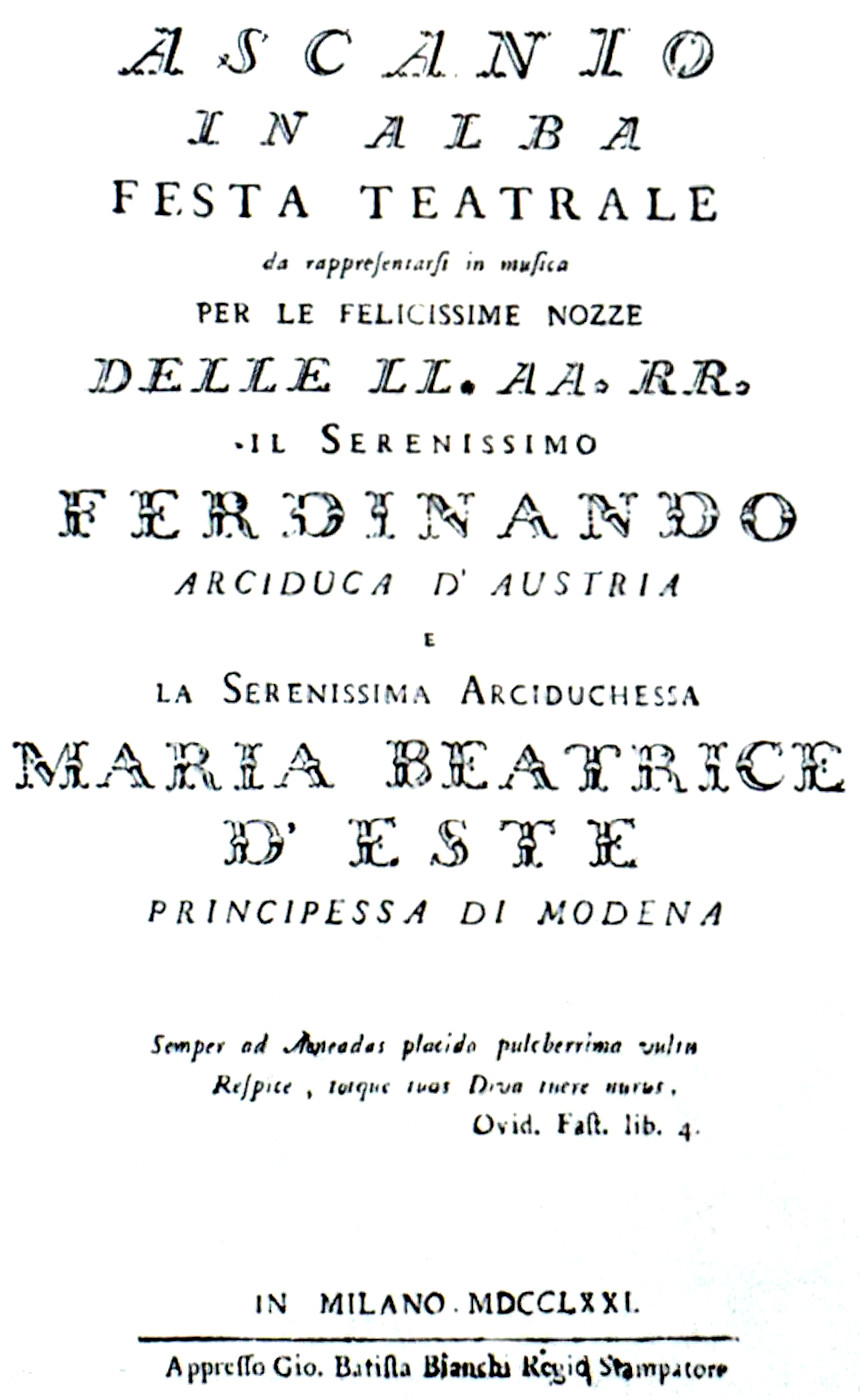
Ascanio in Alba, K. 111, is an opera in two parts (Festa teatrale in due parti) by Wolfgang Amadeus Mozart to an Italian libretto by Giuseppe Parini. The pastoral work was commissioned by the Empress Maria Theresa for the wedding of her son, Archduke Ferdinand Karl, to Maria Beatrice d'Este on 15 October 1771.
Performance history
Ascanio in Alba was first performed at the Teatro Regio Ducale in Milan on 17 October 1771.
It was performed in October 2006 on the 250th anniversary of Mozart's birth at La Scala in Milan, conducted by Giovanni Antonini. The ballet which linked the two acts was twice performed by the orchestra of the Handel and Haydn Society in Boston in 2006.
Instrumentation
The opera is scored for an orchestra consisting of pairs of flutes, oboes, bassoons, trumpets and horns, as well as timpani, a string section and basso continuo (harpsichord, cello).
Synopsis
Place: the site of the future city of Alba Longa, near Rome
Time: mythical times.
Part 1
The opening scene introduces Venus and Ascanio, the son she had by Aeneas. (In most classical sources, Venus/Aphrodite is the mother of Aeneas.) The goddess vaunts the charms of Alba and invites her son to go and rule there. She urges him not to reveal his identity to Silvia, a nymph to whom he is betrothed, but to introduce himself to her under a false identity to test her virtue. While shepherds summon their promised ruler, Fauno reveals that the smiling face of Aceste, a priest, is a sign that the day will be a day of supreme happiness. Obeying the goddess, Ascanio pretends to be a foreigner attracted by the beauties of the place. Aceste tells the shepherds that their valley will be the site of a fine city and that they will have a sovereign, Ascanio, before the day is out. He also informs Silvia that she will be Ascanio's bride, but she replies that she is in love with a young man she has seen in a dream. The priest reassures her, saying the young man in her dream can be none other than Ascanio. Venus then appears to Ascanio and asks him to test the girl a little longer before revealing his true identity.
Part 2
Ascanio spots Silvia among the shepherds and tries to talk to her. The girl immediately recognizes the young man from her dreams. Fauno intervenes and suggests to “the foreigner” (Ascanio) that he should go off and announce the building
of Alba in foreign parts. Thus convinced that the foreigner is not Ascanio, Silvia is deeply saddened. She finally decides to accept her fate but declares she never will love anyone else than Ascanio.
Aceste consoles Silvia, saying that her tribulations are about to come to an end. Venus is invoked by a magnificent chorus. Silvia and Ascanio add their voices to the chorus and the goddess descends on her chariot surrounded by clouds. Venus unites the two lovers and explains how she had intended her son to discover the virtue of his fiancée. Aceste pronounces an oath of fidelity and loyalty to Venus, who then retires. It only remains for Ascanio to perpetuate the race of Aeneas and guide the city of Alba to prosperity.
Ballet music
There is a manuscript, consisting of nine untitled pieces in a keyboard reduction, which has been proposed to be a ballet suite intended for Ascanio in Alba. This group of supplementary works has been catalogued in the Neue Mozart-Ausgabe, given the number K. Anh. 207, and was first published in the new critical edition of the opera, edited by Luigi Ferdinando Tagliavini, in 1956. The pieces were included in an appendix.
Recordings
1959: Ilva Ligabue (Venere), Anna Maria Rota (Ascanio), Emilia Cundari (Silvia), Petre Munteanu (Aceste), Eugenia Ratti (Fauno) – Coro e Orchestra dell'Angelicum di Milano, Carlo Felice Cillario (Cantus Classics)
1976: Mozarteum, Salzburg; Lilian Sukis (Venere), Agnes Baltsa (Ascanio), Edith Mathis (Silvia), Peter Schreier (Aceste), Arleen Auger (Fauno) – Salzburger Kammerchor, Rupert Huber, Mozarteum-Orchester Salzburg, Leopold Hager (CD, 1991)
1990: Lorna Windsor (Venere), Michael Chance (Ascanio), Jill Feldman (Silvia), Howard Milner (Aceste), Rosa Mannion (Fauno) – Chœur de l'Université de Paris-Sorbonne, Concerto Armonico, Jacques Grimbert (Naxos)
2002: Claudia Patacca (Venere), Maaike Beekman (Ascanio), Nicola Wemyss (Silvia), Tom Allen (Aceste), Claron McFadden (Fauno) – Vocaal Ensemble Coqu, Musica ad Rhenum, Jed Wentz (Brilliant Classics)