
REFERENCE Wikipedia, read on Browse · 22 min read
2026 United States Senate elections
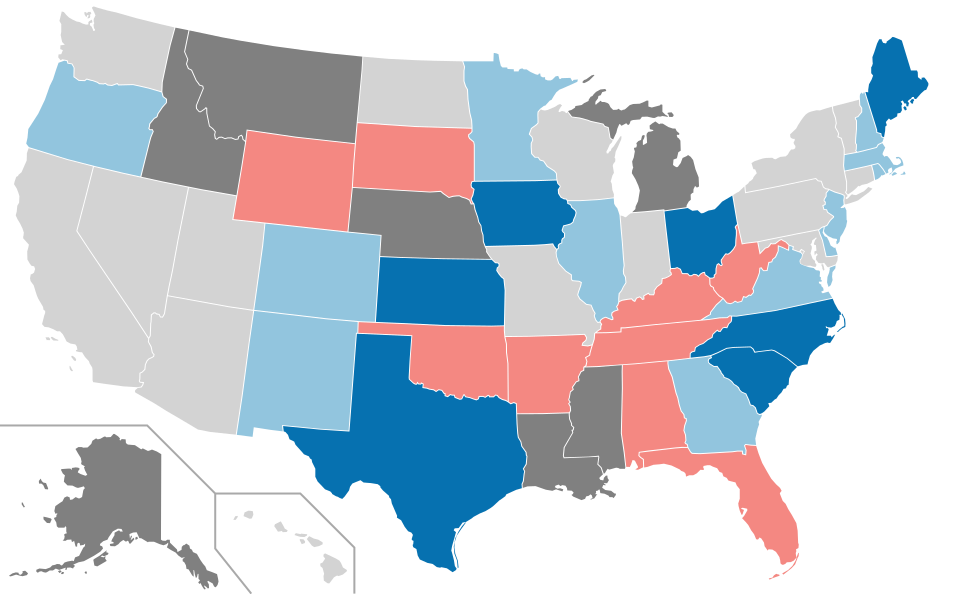
The 2026 United States Senate elections were held on November 3, 2026, with 33 of the 100 seats in the Senate being contested in regular elections. In these elections, voters elected candidates to six-year terms that begin on January 3, 2027, and expire on January 3, 2033. The Democratic Party is projected to have gained a majority, winning at least 54 seats. It also marked the first time since 1954 that the control of the Senate flipped from one party to another in two consecutive election cycles.
Senators are divided into three classes whose terms are staggered, so that a different class is elected every two years. Class 2 senators were last elected in 2020 and are up for election in 2026. With the election of John Thune as leader of the Republican Conference, this will be the first election year since 2006 in which Senate Republicans are not led by Mitch McConnell. The Senate Democratic Conference has been led by Chuck Schumer since 2017.
Special elections are also being held in Ohio and Florida, following the resignation of JD Vance to become vice president and Marco Rubio's resignation to become United States secretary of state. The appointed incumbents in these races are Republicans Jon Husted and Ashley Moody, both of whom are running in their special elections to complete their terms until 2028.
Two incumbent senators—Bill Cassidy of Louisiana and John Cornyn of Texas—lost renomination in their respective primaries, while two nominees—Graham Platner (who dropped out) and Lindsey Graham (who died)—were replaced, respectively by a convention and a special primary, as their party's nominee in Maine and South Carolina. In three states (Idaho, Nebraska, and South Dakota), the Democratic nominee has withdrawn from the race, effectively clearing the field for an independent candidate.
Partisan composition
All 33 Class 2 Senate seats and two Class 3 seats are up for election in 2026. Class 2 currently consists of 20 Republicans and 13 Democrats. Democrats are defending two seats in states won by Donald Trump in 2024, in both cases by less than 3 percentage points: Michigan, where incumbent Gary Peters is not running for reelection; and Georgia, where the incumbent is Jon Ossoff. Michigan elected Democrat Elissa Slotkin to the Senate in 2024 by 0.3 percentage points. Georgia did not have a Senate election in 2024, although in the most recent Senate election, in 2022, Democrat Raphael Warnock won by three points in a runoff.
Five incumbent Democratic senators represent states won by Kamala Harris by single-digit margins in 2024: New Hampshire's Jeanne Shaheen, Minnesota's Tina Smith, Virginia's Mark Warner, New Jersey's Cory Booker, and New Mexico's Ben Ray Luján. Shaheen and Smith are not running for reelection. Susan Collins's seat in Maine is the only seat being defended by a Republican in a state that Kamala Harris won in 2024. Republican Thom Tillis of North Carolina is retiring from the Senate in a state that Trump won by a single-digit margin in 2024.
The 2026 Senate map is considered favorable to Republicans, even though Democrats are defending 13 seats and Republicans 22. Most rating groups identify two Republican-held seats as highly competitive and three or four others as somewhat competitive. By contrast, Democrats must flip at least four seats to win a majority while defending two highly vulnerable seats and two others viewed as somewhat vulnerable. Pollsters have found Democrats' chances to flip the Senate to be improving due to nominees in states such as North Carolina, Ohio, Texas, Kansas, and Alaska running highly competitive campaigns, and because of Donald Trump's unpopularity amid the 2026 Iran war.
Change in composition
Each block represents one of the one hundred seats in the U.S. Senate. "D#" is a Democratic senator, "I#" is an Independent senator, and "R#" is a Republican senator. They are arranged so that the parties are separated and a majority is clear by crossing the middle.
Before the elections
Each block indicates an incumbent senator's actions going into the election.
Gains and holds
Retirements
Eleven senators—four Democrats and seven Republicans—have announced they will not seek reelection. This is the most in a single election cycle since 1996, when thirteen senators chose not to run again.
Defeats
Five Republicans sought reelection, but lost either in the primary election or a special/general election. The last elected incumbent senator to lose renomination was Richard Lugar in 2012, and the last time multiple elected incumbent senators lost renomination in primaries was in 2010. The last incumbent senator to place no better than third in a primary before Cassidy was Hattie Caraway in 1944.
Predictions
Multiple sites and political pundits have published predictions of competitive seats. These predictions have considered factors such as the strength of the incumbent (if the incumbent was running for reelection) and the other candidates, and the state's partisan lean, reflected in part by the state's Cook Partisan Voting Index rating. The predictions typically assign ratings to each seat, indicating the predicted advantage that a party had in winning that seat. Most election predictors use:
"tossup": no advantage
"tilt" (used by some predictors): advantage that is not quite as strong as "lean"
"lean": slight advantage
"likely": significant, but surmountable, advantage
"safe" or "solid": near-certain chance of victory
Potentially competitive seats
These are seats that polling and predictions currently have listed as at least somewhat close.
Republican-held seats with Democratic challengers
One Republican-held senate seat, North Carolina, is considered competitive but favoring the Democrats. Former Governor Roy Cooper overwhelmingly won the Democratic nomination for the open seat. Incumbent Republican senator Thom Tillis is retiring, with former Republican National Committee Chairman Michael Whatley becoming the Republican nominee, endorsed by Donald Trump.
Six Republican-held Senate races are expected to be highly competitive: Maine, Ohio, Alaska, Texas, Iowa, and Kansas. Incumbent Susan Collins is seeking reelection in Maine; it is regarded as competitive due to the state's blue lean, but Collins kept her seat during cycles favorable to Democrats nationally (2008 and 2020). Military veteran Graham Platner was the Democratic nominee in Maine until he withdrew from the race due to allegations of sexual assault. He was replaced by former Maine Senate president Troy Jackson. Incumbents in Ohio (Jon Husted) and Alaska (Dan S. Sullivan) are expected to have competitive races against former U.S. senator Sherrod Brown and former U.S. representative Mary Peltola, respectively. Both Brown and Peltola lost reelection in 2024. In Texas, incumbent Senator John Cornyn lost the Republican primary election to Texas Attorney General Ken Paxton, who is expected to have a competitive race against State Representative James Talarico. In Iowa, the incumbent Joni Ernst is not seeking reelection; the race to succeed her between Republican U.S. representative Ashley Hinson and Democratic state representative Josh Turek is expected to be competitive. In Kansas, the gap between the Democratic nominee, pastor Adam Hamilton, and incumbent Senator Roger Marshall narrowed in early October polls.
Four other Republican-held Senate races are expected to favor Republicans over Democrats but are viewed as somewhat competitive by some predictors: Florida, Mississippi, South Carolina, and Louisiana. In Louisiana, incumbent Senator Bill Cassidy was challenged by Louisiana State Treasurer John Fleming and U.S. representative Julia Letlow, with Letlow winning the primary election, marking the first time an elected incumbent senator had lost their primary in any state since 2012 in Indiana.
Republican-held seats with independent challengers
Four Senate races with Republican incumbents have independent candidates as the main challengers to the Republicans: Nebraska, Idaho, Montana, and South Dakota. In Nebraska, Idaho, and South Dakota, the Democratic candidates dropped out of the race. In Nebraska, incumbent Senator Pete Ricketts is challenged by independent Dan Osborn, who ran against Republican Deb Fischer in the Class I race in 2024. Osborn was the most successful challenger of a Republican-held seat during the 2024 election cycle, losing by only 6.7 points, compared to Kamala Harris's loss by 20.5 points in Nebraska in the concurrent presidential election. In August 2026, the Nebraska Democratic Party endorsed Osborn. In Montana, Republican Kurt Alme, former United States Attorney for the District of Montana faces former University of Montana president Seth Bodnar, an independent, Democrat Alani Bankhead, a retired Air Force lieutenant colonel, and Libertarian Kyle Austin. On October 12, Bodnar was endorsed by Shannon O'Brien, who resigned as Montana's Democratic Party chair to do so. Several prominent Montana Democrats have urged Bankhead to drop out, but she has refused.
Democratic-held seats
The Democratic-held Senate race expected to be the most competitive is in Michigan, where senator Gary Peters has announced his retirement. The state has an even PVI score. Former US Representative for the 8th congressional district and 2024 U.S. Senate nominee Mike Rogers is the Republican nominee. Former Wayne County Health, Human, and Veterans Services Department Director Abdul El-Sayed is the Democratic nominee. In New Hampshire, where incumbent Democratic senator Jeanne Shaheen is retiring, the race is also expected to be competitive. U.S. Representative Chris Pappas is the Democratic nominee and former U.S. Senator John E. Sununu is the Republican nominee. Sununu lost to Shaheen in 2008. Some polls have shown the race as a dead heat, with two August polls showing Sununu ahead.
In Georgia, incumbent Democratic senator Jon Ossoff is running against Republican Mike Collins, the U.S. representative from Georgia's 10th congressional district. The race was initially expected to be very competitive, but election predictors have become increasingly confident of Ossoff's prospects.
Race summary
Special elections during the preceding Congress
Special U.S. Senate elections in Florida and Ohio are scheduled for November 3, 2026. Florida voters will elect a candidate to serve the remaining two years of former Senator Marco Rubio's unexpired term; Rubio resigned his seat in 2025 to become United States Secretary of State. Ohio voters will elect a candidate to serve the remaining two years of former Senator JD Vance's unexpired term; Vance resigned in 2025 to become Vice President of the United States.
Elections are sorted by date then state.
Elections leading to the next Congress
In these general elections, the winners will be elected for the term beginning January 3, 2027.
Alabama
Republican Tommy Tuberville, who was elected in 2020 with 60.1% of the vote, initially planned to seek reelection. But on May 27, 2025, he announced that he would instead run for governor of Alabama.
Held on May 19, the Republican primary featured U.S. Representative Barry Moore, former Navy SEAL Jared Hudson, and state attorney general Steve Marshall. Since no candidate reached 50%, a runoff was held on June 16 between the top two finishers. Moore won the runoff, becoming the Republican nominee.
In the Democratic primary, no candidate received 50%, so a runoff was held between businessman Dakarai Larriet and attorney Everett Wess. Wess won the runoff with 54.6% of the vote.
Alaska
Two-term Republican Dan S. Sullivan was reelected in 2020 with 53.9% of the vote. He is running for reelection to a third term.
A nonpartisan primary was held on August 18, 2026, with the top four candidates advancing to the general election, which will be conducted using ranked-choice voting. The advancing candidates are incumbent Republican senator Dan S. Sullivan, perennial Republican candidate Gerald Heikes, former Democratic U.S. representative Mary Peltola, and former U.S. Forest Service employee Dan J. Sullivan, despite efforts to disqualify him. Some Republicans have alleged that Dan J. Sullivan's candidacy is intended to confuse voters seeking to support the incumbent senator, who shares his first and last names.
Arkansas
Two-term Republican Tom Cotton was reelected in 2020 with 66.5% of the vote. Cotton is running for reelection, having secured the Republican nomination on March 3, 2026.
Rice farmer Hallie Shoffner defeated Ethan Dunbar in the March 3 Democratic primary.
Colorado
One-term Democrat John Hickenlooper, elected with 53.5% of the vote in 2020, is running for reelection for a second term, and has said it will be his last term. Hickenlooper defeated progressive state Senator Julie Gonzales in the Democratic primary, 53% to 47%.
State Senator Mark Baisley is the Republican nominee following the Colorado Republican Assembly on April 11, as no other candidates surpassed the 30% threshold.
Delaware
Two-term Democrat Chris Coons was reelected in 2020 with 59.4% of the vote and is running for reelection.
Coons faced three challengers in the Democratic primary: philosopher and educator Jeff Appelhans, E. No-Trump Hansen, and domestic violence advocate Mary Louve. Coons won the nomination with approximately 78% of the vote.
Former Democratic state Senator and Independent Party of Delaware nominee for U.S. Senate in 2024 Michael Katz defeated U.S. Army War College instructor John Shulli in the Republican primary.
Florida (special)
Three-term Republican Marco Rubio was reelected in 2022 with 57.68% of the vote. He resigned on January 20, 2025, following his confirmation as U.S. Secretary of State. Governor Ron DeSantis subsequently appointed Florida Attorney General Ashley Moody to serve as interim senator until the 2026 special election. Moody ran to serve the remainder of Rubio's term and won the Republican nomination in the August 18 primary.
State Representative Angie Nixon defeated Alex Vindman, former director for European affairs at the U.S. National Security Council, a whistleblower in the 2019 Trump–Ukraine scandal, and the twin brother of Virginia U.S. Representative Eugene Vindman in the August 18 Democratic primary.
Georgia
One-term Democrat Jon Ossoff is running for a second term. He was narrowly elected in a 2021 runoff with 50.6% of the vote. Ossoff won the Democratic nomination unopposed, as he was the only candidate to submit the required number of signatures to appear on the primary ballot.
The Republican primary took place on May 19. U.S. Representative Mike Collins and former University of Tennessee football coach Derek Dooley advanced to a June 16 runoff, which Collins won with 56% of the vote.
Idaho
Three-term Republican Jim Risch was reelected in 2020 with 62.6% of the vote and is running for a fourth term. He won the Republican nomination on May 19, defeating data engineer and 2020 Libertarian nominee for Idaho's 1st congressional district Joe Evans, entrepreneur Denny LaVe, and engineer Josh Roy.
David Roth, a realtor and the Democratic nominee for U.S. Senate in 2022, defeated Nickolas Bonds and Brad Moore in the May 19 Democratic primary, but withdrew from the race on July 28.
Matt Loesby, the nominee for Idaho's 1st congressional district in 2024, is running as a Libertarian. Former Democratic state representative Todd Achilles and software developer Natalie Fleming are running as independents.
Illinois
Five-term Democrat and Senate Democratic Whip Dick Durbin was reelected in 2020 with 54.9% of the vote. On April 23, 2025, he announced he would not run for reelection.
On March 17, 2026, incumbent Lieutenant Governor Juliana Stratton won the Democratic primary, defeating a crowded field, including U.S. Representatives Raja Krishnamoorthi and Robin Kelly.
Former Illinois Republican Party Chairman Don Tracy easily won the Republican primary the same day, defeating attorney Jeannie Evans and Polish American Congress PAC national director Casey Chlebek.
Iowa
Two-term Republican Joni Ernst was reelected in 2020 with 51.7% of the vote. On September 2, 2025, she announced that she would not seek reelection to a third term, after being criticized for comments about reductions in Medicaid.
U.S. Representative Ashley Hinson easily defeated former state Senator Jim Carlin in the June 2, 2026, Republican primary to succeed Ernst.
In the Democratic primary, state Representative Josh Turek defeated state Senator Zach Wahls by a comfortable margin. Both candidates had cited Ernst's remarks about Medicare as a factor in their decisions to run.
Kansas
One-term Republican Roger Marshall was elected in 2020 with 53.2% of the vote and is running for reelection.
Founder of the Church of the Resurrection and pastor Adam Hamilton, who initially considered running as an independent, won the Democratic nomination with 35% of the vote. He defeated a field that included former state USDA Director Christy Davis, former federal prosecutor Jason Hart, commercial real estate developer Erik Murray, attorney Anne Parelkar, state senator Patrick Schmidt, art gallery owner Mike Soetaertare, former financial services executive Sandy Spidel Neumann, and counterintelligence specialist Noah Tyler.
Kentucky
Seven-term Republican and former Senate Republican Leader Mitch McConnell was reelected in 2020 with 57.8% of the vote. McConnell retired as leader after the 2024 elections with plans to serve out the remainder of his term. On February 20, 2025, McConnell announced he would not seek reelection.
On May 19, U.S. Representative Andy Barr of Kentucky's 6th congressional district defeated a crowded field that included former Kentucky Attorney General and 2023 Republican gubernatorial nominee Daniel Cameron for the Republican nomination.
Former state Representative Charles Booker, the 2022 Senate nominee and a former staffer for Governor Andy Beshear, won the May 19 Democratic primary. The seven-candidate field included 2020 nominee and former Marine fighter pilot Amy McGrath.
Louisiana
Two-term Republican Bill Cassidy was reelected in 2020 with 59.3% of the vote in the first round of the "Louisiana primary" and ran for reelection to a third term, but placed a distant third in the jungle primary. The Louisiana primary system had since been eliminated in favor of partisan primaries, which were closed to members of other parties but open to unaffiliated voters.
U.S. Representative Julia Letlow and state Treasurer and former U.S. representative John Fleming advanced to the Republican runoff, defeating Cassidy in the primary. Letlow, who was endorsed by President Donald Trump, defeated Fleming in the runoff.
Sorghum farmer Jamie Davis and data scientist and political consultant Gary Crockett advanced to the Democratic primary runoff, while nonprofit executive Nick Albares placed third. Davis defeated Crockett in the runoff.
Maine
Incumbent Republican Senator Susan Collins was reelected with 51% of the vote to 42% for her Democratic opponent in 2020. She formally announced her reelection campaign in February 2026. As the only person to submit the necessary number of signatures to appear on the primary ballot, Collins is the Republican nominee.
According to Federal Election Commission (FEC) records, as of October 2026, Collins has received $4,525,846 from political action committees (PACs) affiliated with pro-Israel lobbies; of this amount, $3,670,038 is attributed to the 2026 election cycle.
Throughout 2025, Governor Janet Mills was seen as a potential Democratic challenger to Collins. She announced her Senate candidacy in October, and pledged to serve only one term if elected. She suspended her campaign on April 30, 2026, due to a lack of financial resources and poor polling numbers.
On June 9, Sullivan harbor master and Marine veteran Graham Platner defeated former deputy secretary of the Maryland Department of the Environment David Costello for the Democratic nomination with 72% of the vote.
On July 8, Platner announced his withdrawal from the race, following allegations of sexual assault, which he denied. The same day, Maine Democrats voted to hold a state convention to select a replacement nominee. Candidates seeking the nomination were required to collect at least 500 signatures, including 50 from each of eight counties. During county meetings to select convention delegates, approximately 456 delegates pledged their support to former state Senator Troy Jackson. Jackson subsequently defeated Saundra Pelletier at the convention by a vote of 566–5.
Massachusetts
Two-term Democrat Ed Markey was reelected in 2020 with 66.2% of the vote and is seeking a third full term. The longest-serving Democrat in Congress, Markey will be 80 on Election Day and has faced calls to retire. This also happened during the 2020 Democratic primary. Markey defeated U.S. Representative Seth Moulton in the September 1 Democratic primary.
Attorney John Deaton, who was the Republican nominee against U.S. Senator Elizabeth Warren in 2024, is again the Republican nominee.
Michigan
Two-term Democrat Gary Peters was narrowly reelected in 2020 with 49.9% of the vote. On January 28, 2025, he announced that he would not seek reelection.
Former Wayne County Health, Human, and Veterans Services Department Director Abdul El-Sayed, U.S. Representative Haley Stevens of the 11th congressional district, and State Senator Mallory McMorrow ran in the Democratic primary. El-Sayed narrowly defeated Stevens and is the Democratic nominee.
Former U.S. Representative for the 8th congressional district and 2024 U.S. Senate nominee Mike Rogers is the Republican nominee.
Minnesota
One-term Democrat Tina Smith was reelected in 2020 with 48.7% of the vote after being appointed by Governor Mark Dayton in 2018 following Al Franken's resignation and then winning a special election that year. On February 13, 2025, she announced she would not seek a second full term in 2026. Incumbent Lieutenant Governor Peggy Flanagan announced her candidacy the same day. U.S. Representative Angie Craig announced her candidacy on April 29. Flanagan won the nomination with 59% of the vote.
Republicans running included sportscaster Michele Tafoya, 2024 Republican U.S. Senate nominee and former professional basketball player Royce White, retired U.S. Navy officer Tom Weiler, and former Navy SEAL Adam Schwarze. Tafoya ultimately won the nomination with 52% of the vote.
Mississippi
One-term Republican Cindy Hyde-Smith was reelected in 2020 with 54.1% of the vote after being appointed in 2018 and winning a special election later that year. She is running for a second full term in office. She defeated physician Sarah Adlakha in the Republican primary on March 10, 2026.
Lowndes County District Attorney Scott Colom defeated U.S. Marine Corps veteran Albert Littell, and Priscilla Williams-Till, a cousin of Emmett Till, in the Democratic primary on March 10, 2026.
Ty Pinkins, the Democratic nominee for Secretary of State in 2023 and for U.S. Senate in 2024, is running as an independent.
Montana
Two-term Republican Steve Daines was reelected in 2020 with 55% of the vote. On March 4, 2026, Daines announced he would not seek reelection. The same day, U.S. Attorney Kurt Alme announced his candidacy and immediately won Daines's endorsement.
Former state Representative Reilly Neill ran for the Democratic nomination, but was defeated in the Democratic primary by former U.S. Air Force Lieutenant Colonel Alani Bankhead in a major upset.
Seth Bodnar, the president of the University of Montana until January 2026, is running as an independent candidate. Despite calls from dozens of local Democratic lawmakers to withdraw in favor of Bodnar, Alani Bankhead refused to do so.
Nebraska
Two-term Republican Ben Sasse resigned early in the 118th Congress to become president of the University of Florida. On January 12, 2023, Governor Jim Pillen appointed former governor Pete Ricketts as senator. Ricketts won the 2024 special election to complete Sasse's term, defeating college professor Preston Love Jr., and is now running for reelection to his first full term.
Former labor union leader Dan Osborn, who challenged Republican Deb Fischer for Nebraska's Class I Senate seat, has announced an independent bid.
The Nebraska Democratic Party has declined to recruit a Democratic challenger to Ricketts, and the party's chair has endorsed Osborn. Other candidates filed for the Democratic primary, raising concern that their campaigns could split the vote and weaken Osborn's support in the general election, but retired pharmacy technician Cindy Burbank won the Democratic primary and said she intended to withdraw from the general election if she saw no clear path to victory. She officially withdrew from the race on July 17.
New Hampshire
Three-term Democrat Jeanne Shaheen was reelected in 2020 with 56.6% of the vote. On March 12, 2025, Shaheen announced that she would not seek reelection to a fourth term.
U.S. Representative Chris Pappas defeated New Hampshire Democratic Party rules committee member Karishma Manzur to win the Democratic nomination on September 8.
Former U.S. Senator John E. Sununu won the Republican nomination on September 8, defeating former Massachusetts U.S. Senator and U.S. Ambassador to New Zealand and Samoa Scott Brown. Both have previously lost Senate races to Shaheen: Sununu in 2008 and Brown in 2014. Sununu's brother, former Governor Chris Sununu, declined to run.
New Jersey
Two-term Democrat Cory Booker was reelected in 2020 with 57.2% of the vote and is running for reelection to a third full term. Booker won the Democratic nomination unopposed, as he was the only candidate to submit the required number of signatures to appear on the primary ballot.
On June 2, 2026, former Tabernacle Mayor Justin Murphy, a Navy veteran and attorney, won the Republican nomination with 33% of the vote, defeating physician Robert Lebovics, U.S. Army combat veteran Richard Tabor, and former News 12 reporter Alex Zdan.
New Mexico
One-term Democrat Ben Ray Luján was elected in 2020 with 51.7% of the vote. On April 23, 2025, Luján announced that he would seek a second term.
Christopher Heuvel, the only Republican to file, was disqualified for failing to meet ballot requirements. Former oil and gas operator Larry Marker subsequently qualified for the Republican primary as a write-in.
North Carolina
Two-term Republican Thom Tillis, who was narrowly reelected in 2020 with 48.7% of the vote, announced on June 29, 2025, that he would not seek a third term after facing backlash for voting against One Big Beautiful Bill Act, prompting Donald Trump to call for a primary challenger. After Tillis withdrew, Trump endorsed former Republican National Committee chair Michael Whatley, who won the Republican nomination, defeating Don Brown in the March 3 primary.
Lara Trump, former co-chair of the Republican National Committee and Wilmington native, was considered a potential candidate to challenge Tillis, but announced she would not run.
On the Democratic side, former U.S. Representative Wiley Nickel declared his candidacy in April 2025. Former Governor Roy Cooper entered the race on July 28, 2025. Nickel withdrew the following day and endorsed Cooper, who later won the Democratic nomination.
Ohio (special)
One-term Republican JD Vance was elected in 2022 with 53% of the vote. On January 10, 2025, he resigned from the Senate after being elected Vice President of the United States in 2024. On January 17, Governor Mike DeWine announced that then-Lieutenant Governor Jon Husted would replace Vance in the Senate. Husted is running to serve the remainder of Vance's term.
Former U.S. Senator Sherrod Brown, who was unseated in 2024, defeated IT professional Ron Kincaid in the Democratic primary on May 5, 2026.
Former Libertarian National Committee chair William Redpath is running as a Libertarian. Ohio Libertarians disqualified healthcare consultant Jeffrey Kanter from the Libertarian primary after he submitted hundreds of invalid signatures with his candidate petition.
Oklahoma
Incumbent Republican Markwayne Mullin won a special election in 2022 with 61.8% of the vote to complete the remainder of the term vacated by Jim Inhofe, who resigned on January 3, 2023, due to declining health and died in 2024.
Mullin initially announced plans to seek his first full term in office, but on March 5, 2026, President Trump announced his nomination of Mullin for Secretary of Homeland Security; the Senate confirmed Mullin on March 23. Governor Kevin Stitt appointed board member and former CEO of Williams Companies Alan Armstrong to replace Mullin in the Senate. Armstrong was sworn in on March 24 and was required to sign an oath stating that he would not run in the 2026 election.
U.S. Representative for Oklahoma's 1st congressional district Kevin Hern won the June 16 Republican primary with 70% of the vote in a crowded field.
In the June 16 Democratic primary, mediator Jim Priest and nurse N'Kiyla "Jasmine" Thomas received the most votes and advanced to an August 25 runoff. Thomas, a member of the Democratic Socialists of America, won the runoff with 61% of the vote.
Entering Wedge Media executive director Ron Meinhardt and pharmacist Curtis Stinnett are running as independents. Sevier White, candidate for Oklahoma's 4th congressional district in 2016, is running as a Libertarian.
Oregon
Three-term Democrat Jeff Merkley was reelected in 2020 with 56.9% of the vote. On July 20, 2025, he announced his candidacy for reelection. He defeated retired electrical engineer Paul D. Wells in the Democratic primary on May 19, 2026.
State Senator David Brock Smith, won the Republican primary that was held on May 19, 2026, defeating a crowded field of candidates, with former Linn County Republican Party chair Jo Rae Perkins finishing second.
Rhode Island
Five-term Democrat Jack Reed was reelected in 2020 with 66.5% of the vote and is running for a sixth term. He won the Democratic primary on September 9, defeating elder care worker Connor Burbridge and physician Luis Daniel Muñoz.
Former Rhode Island Republican Party official Raymond McKay is the Republican nominee.
South Carolina
Four-term Republican Lindsey Graham was reelected in 2020 with 54.4% of the vote and was seeking a fifth term. He won the June 9 Republican primary with 57% of the vote, but died in office on July 11. Governor Henry McMaster appointed Lindsey Graham's sister, Darline Graham, to serve the remainder of his term. She subsequently sought a full term. In the August 11 special Republican primary, Darline Graham and U.S. Representative Ralph Norman advanced to an August 25 runoff, which Graham won with 52% of the vote to Norman's 48%.
Pediatrician Annie Andrews won the Democratic primary with 61% of the vote.
South Carolina Libertarian Party nominee Kasie Whitener and Constitution Party nominee Mark Hackett were nominated by convention. 2022 US Senate candidate Catherine Fleming Bruce is running as a write-in candidate.
South Dakota
Two-term Republican Mike Rounds, who was reelected in 2020 with 65.7% of the vote, is running for a third term. Rounds easily defeated Navy veteran and businessman Justin McNeil in the June 2 primary to win the Republican nomination.
Businessman and former South Dakota state trooper Julian Beaudion was the Democratic nominee, but withdrew on August 4.
Brian Bengs, a U.S. Navy and Air Force veteran, former Northern State University political science professor, and the Democratic nominee for U.S. Senate in 2022, has announced his candidacy as an independent.
Tennessee
Republican Bill Hagerty was elected in 2020 with 62.2% of the vote and is seeking reelection. Hagerty became the Republican nominee unopposed after no other Republicans qualified for the primary ballot.
Consultant Marquita Bradshaw won the Democratic nomination on August 6.
Texas
Four-term Republican John Cornyn was reelected in 2020 with 53.5% of the vote, and ran for a fifth term in 2026.
Cornyn and state Attorney General Ken Paxton ran in the Republican primary on March 3. Since neither received more than 50% of the vote, they advanced to a runoff election held on May 26. U.S. Representative for the 38th congressional district Wesley Hunt challenged Paxton and Cornyn, but lost the primary. On May 19, both Hunt and President Trump endorsed Paxton. Paxton defeated Cornyn in the runoff by a landslide and became the Republican nominee.
State Representative James Talarico is the Democratic nominee, having defeated U.S. Representative Jasmine Crockett in the primary.
Virginia
Three-term Democrat Mark Warner was reelected in 2020 with 56% of the vote and is running for reelection. As the only person to submit the necessary number of signatures to appear on the primary ballot, Warner is the Democratic nominee.
Retired United States Army Major General Bert Mizusawa, who previously ran for U.S. Senate in 2018 and Virginia's 2nd congressional district in 2010, won the Republican nomination over Certified Public Accountant Kim Farrington and U.S. Marine Corps Reserve Colonel David Williams.
West Virginia
Two-term Republican Shelley Moore Capito was reelected in 2020 with 70.3% of the vote and is running for reelection to a third term. She won the Republican primary on May 12.
Former Morgantown City Councilwoman Rachel Fetty Anderson won the Democratic primary on May 12, 2026.
Wyoming
One-term Republican Cynthia Lummis was elected in 2020 with 72.8% of the vote and is not seeking reelection.
U.S. Representative Harriet Hageman defeated Wyoming Army National Guard veteran Jimmy Skovgard for the Republican nomination on August 18, 2026.
Former state Representative James W. Byrd defeated landscaper Billy Benavidez for the Democratic nomination on August 18, 2026.