
REFERENCE Wikipedia, read on Browse · 3 min read
2026 Toledo train collision
High-speed train collision in Spain
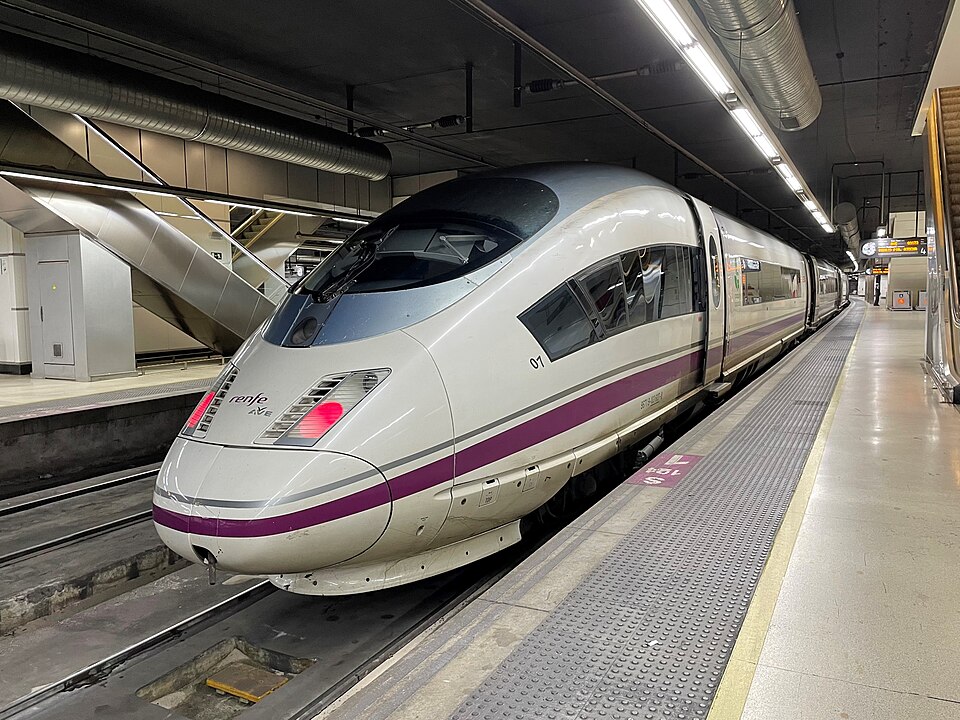
On 28 October 2026 at 08:54 CET(UTC+01:00), an AVE high-speed train collided with a stationary Iryo high-speed train in Los Yébenes, Toledo, on the Madrid–Seville high-speed rail line, killing at least 69 people. The crash was the second major train disaster in Spain in 2026, following the Adamuz rail disaster in January, which killed 46 people. Both trains involved in the crash were travelling from Atocha station in Madrid to Santa Justa station in Seville. Government sources gave human error in the manual operation of signalling, after an automated system had failed, as the likely cause of the crash.
Collision
At 07:54 CET, train 6076 operated by Iryo departed from Madrid Atocha railway station bound for Seville–Santa Justa railway station, with 147 people on board. Six minutes later, at 08:00, AVE train 2080 departed from the same station, also bound for Seville–Santa Justa, with 397 people on board.
The crash occurred between the towns of Mora and Orgaz in the province of Toledo at 08:54, at the 118km marker on the Madrid–Seville high-speed rail line. The Iryo train was stationary when it was hit by the AVE train. Two carriages fell down an embankment. A rail from the track lifted up and pierced a carriage, visibly protruding from it.
According to El País, the LZB automatic signalling system had failed and the train was operating under human control. Government sources indicated that human error by an operator at the Administrador de Infraestructuras Ferroviarias (ADIF) was the probable cause of the accident.
Victims
At least 74 people were killed in the crash. More than 100 people were injured; 58 were hospitalised, including 15 in serious condition. One of the dead was hit by the rail that pierced a carriage, according to a surviving passenger.
Fátima Báñez, the former Minister of Employment and Social Security, was killed in the accident; she was in the last carriage of the Iryo train. Opera composer Marisa Manchado is also reported missing. One surviving passenger had also been aboard during the Adamuz disaster that killed 46 people nine months earlier, having come out physically uninjured both times.
Aftermath
Emergency services requested that the mayor of Urda, Manuel Galán, convert the sports hall into a refuge for the injured. Local residents were also at the scene providing water and assisting the injured. Eight firefighting personnel and eight emergency response units were the first at the scene. Additional crew from the Andalusian Health Service, Madrid City Council, and SAMUR were also dispatched. The Regional Government of Castilla–La Mancha and the Military Emergencies Unit were also on alert. Three helicopters and two mobile intensive care units were dispatched to the scene. The Spanish Civil Guard deployed more than 900 personnel to the crash site and established bureaus in Madrid, Toledo, Seville and Córdoba to investigate reports of missing persons. High-speed services between Madrid and Andalusia were suspended.
Investigation
The Independent Authority for the Technical Investigation of Accidents and Incidents (AITAT) is responsible for investigating railway accidents in Spain. A recording of the communications between the ADIF control centre and the trains was leaked to the media. Óscar Puente, the Minister of Transport and Sustainable Mobility, went to ADIF's control centre in Atocha to learn the details of the incident. He described it as "inexplicable" that ADIF's control centre authorised the AVE high-speed train to resume normal operation when the Iryo train was still stationary in front of it.
Reactions
Spanish prime minister Pedro Sánchez released a statement that he was in contact with Puente and the president of Castilla-La Mancha, Emiliano García-Page, and that "all [his] thoughts are with the victims and their families". King Felipe VI and Queen Letizia also issued a statement sending their "heartfelt support to the injured and all those affected". Three days of national mourning were declared by Sánchez, who also visited the crash site. Flags at the offices of the European Commission, the Council of the European Union and the European Parliament were also set to half-mast in solidarity over the disaster.
All 24 Copa del Rey first-round matches scheduled for 28 October were postponed by the Royal Spanish Football Federation (RFEF) as a mark of respect for the victims of the collision. Several Spanish football clubs, including Real Madrid and Barcelona, expressed condolences to the victims and their families. All political parties except Vox suspended campaigning ahead of the forthcoming general election. A spokesman for Vox stated that the party saw the suspension of campaigning as an attempt to "use mourning to silence criticism".
A demonstration was held in front of the Transport Ministry building in Madrid, which was attended by more than 1,500 people. Protesters demanded the resignation of Sánchez and Puente before being dispersed by police with tear gas after demonstrators hurled bottles and flares.