
REFERENCE Wikipedia, read on Browse · 32 min read
2026 Serbian parliamentary election
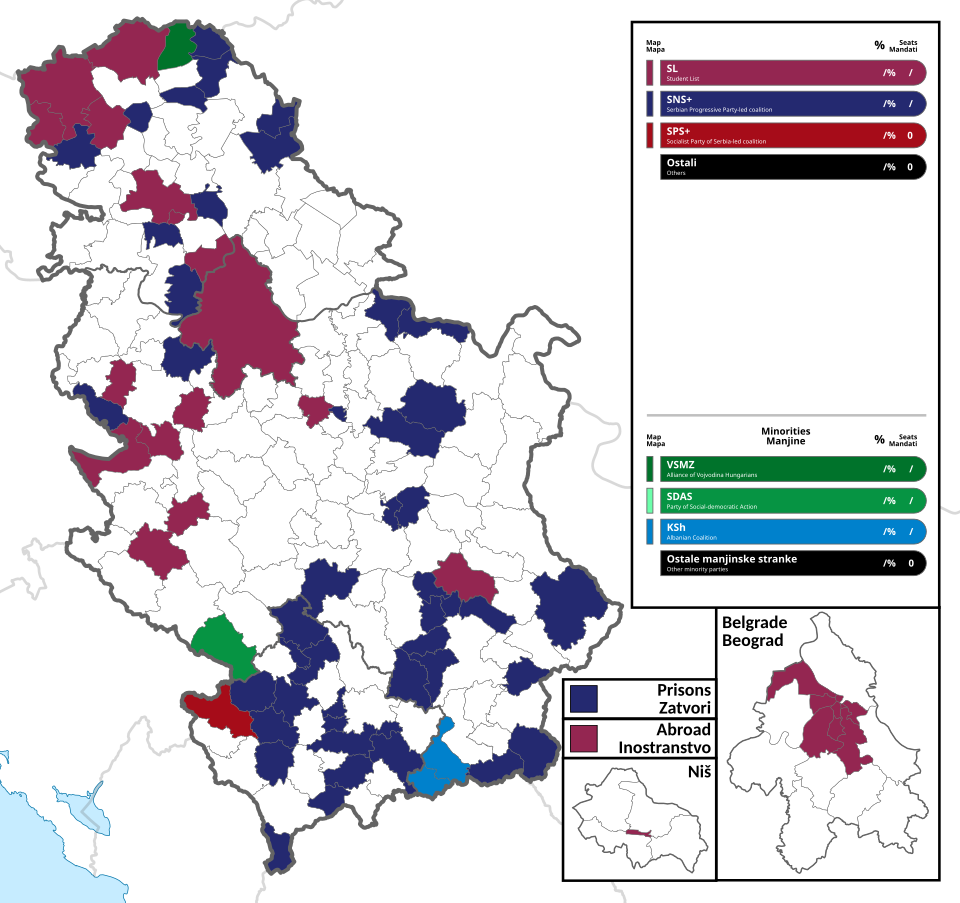
Early parliamentary elections were held in Serbia on 25 October 2026 to elect members of the National Assembly. The elections were originally due by December 2027; Aleksandar Vučić, then the president of Serbia, dissolved the National Assembly and called the elections on 9 September 2026, on the proposal of the government. The Student List won the election with a projected absolute majority of seats, defeating the Serbian Progressive Party (SNS), which had been in power since 2012. According to the CeSID–Ipsos projection, the Student List won about 52% of the vote and 140 seats, while the SNS-led "Aleksandar Vučić – United Serbia" list won 39% and 103 seats; besides national minority lists, no other list crossed the electoral threshold. Turnout was around 70%, substantially higher than in 2023. Vučić conceded defeat on election night.
The Serbian Progressive Party (SNS) came to power in 2012 after forming a government with the Socialist Party of Serbia (SPS). In the 2023 parliamentary election, SNS regained its parliamentary majority. Protests were briefly organised after the elections due to alleged electoral fraud. Miloš Vučević became the prime minister of Serbia in May 2024. In the aftermath of the Novi Sad railway station canopy collapse in November 2024, the student-led anti-corruption protests began, while in January 2025, Vučević announced his resignation from office. He was succeeded by Đuro Macut in April. In 2026, changes to several election laws were adopted by the National Assembly.
SNS nominated Vučić as its candidate for prime minister and the head of its electoral list, "Aleksandar Vučić – United Serbia"; he resigned as president on 27 September, with Ana Brnabić, the president of the National Assembly, becoming acting president. The students contested the elections as the Student List, headed by Ilija Srdanović, which was endorsed by several parliamentary and extra-parliamentary parties, most of which withdrew their own lists in its favour. Parties that did not withdraw included pro-European "European Serbia" coalition, and the nationalist "Authentic Right", which led to accusations of them being "false opposition" ("lažna opozicija") meant to be spoilers for SNS. The campaign ended with the start of the election silence on 23 October, while the presidential election triggered by Vučić's resignation must be held by 27 December 2026.
Background
A populist coalition, led by the Serbian Progressive Party (SNS), came to power after the 2012 election, along with the Socialist Party of Serbia (SPS). Aleksandar Vučić, who initially served as deputy prime minister of Serbia and later as prime minister of Serbia, was elected president of Serbia in 2017 and re-elected in 2022. Since he came to power, observers have assessed that Serbia has suffered from democratic backsliding into authoritarianism, followed by a decline in media freedom and civil liberties. The V-Dem Institute has categorised Serbia as an electoral autocracy since 2014, while Freedom House noted in 2024 that SNS "eroded political rights and civil liberties, put pressure on independent media, the opposition, and civil society organisations". On the other hand, supporters highlight the pragmatism of SNS and Vučić, as well as economic growth.
On 17 December 2023, a snap parliamentary election was held in Serbia. The election resulted in a victory of the SNS-led Serbia Must Not Stop electoral alliance that won a majority of seats in the National Assembly of Serbia. The second place was obtained by Serbia Against Violence (SPN), a broad coalition of opposition parties, that won 65 seats in total. The SPS electoral alliance, however, collapsed in popularity and only won 18 seats, its worst result since the 2007 parliamentary election. According to non-governmental and monitoring organisations, election day was marked by electoral fraud and irregularities such as the Bulgarian train and vote buying. After the election, protests were held up to 30 December, with its organisers, including SPN, calling for the results to be annulled. Amidst the protests, a riot occurred after an unsuccessful attempt from opposition councillors to enter the building of the City Assembly of Belgrade. After several months of negotiations, SNS formed a new government on 2 May, with Miloš Vučević, the president of SNS, as prime minister.
Student-led protests
In the aftermath of the Novi Sad railway station canopy collapse in November 2024, ministers Goran Vesić and Tomislav Momirović announced their resignation from office. Their resignation was acknowledged by the National Assembly on 25 November. Student-led anti-corruption protests also began in November 2024, with one of the demands being the release of Novi Sad railway station canopy documents to the public. An estimated 100,000 demonstrators attended the protest on Slavija Square on 22 December. A series of acts of civil disobedience, promoted as a "general strike", took place on 24 January 2025. An estimated 325,000 or more demonstrators attended the protest on 15 March 2025.
After a group of students were physically attacked in Novi Sad, Vučević announced his resignation from office on 28 January. His resignation was acknowledged by the National Assembly on 19 March. Đuro Macut succeeded Vučević as prime minister on 16 April. Macut is the third independent politician to be nominated for the office of prime minister of Serbia. After his appointment, the student movement demanded a snap parliamentary election and announced that it would take part in it.
As of September 2026, the protests were still ongoing. The largest protest of 2026 was held at Slavija on 23 May and was attended by between 180,000 and 190,000 people, according to the non-governmental organisation Archive of Public Gatherings.
Electoral system
The 250 members of the National Assembly are elected by closed-list proportional representation from a single nationwide constituency. Eligible voters vote for electoral lists, on which the candidates of the accepted lists are present. A maximum of 250 candidates could be present on a single electoral list. An electoral list could be submitted by a registered political party, a coalition of political parties, or a citizens' group. To submit an electoral list, at least 10,000 valid signatures must be collected, though ethnic minority parties only need to collect 5,000 signatures to qualify on the ballot. At least 40% of candidates on electoral lists must be female. The electoral list is submitted by its chosen representative or representatives. An electoral list could be declined, after which those who submitted it can fix the deficiencies in a span of 48 hours, or rejected, if the person is not authorised to nominate candidates. The name and date of the election, names of the electoral lists and its representatives, and information on how to vote are only present on the voting ballot.
The Republic Electoral Commission (RIK), local election commissions, and polling boards oversee the election. Seats are allocated using the d'Hondt method with an electoral threshold of 3% of all votes cast, although the threshold is waived for ethnic minority parties. The seats are distributed by dividing the total number of votes received by the electoral list participating in the distribution of seats by each number from one to 250. If two or more electoral lists receive the same quotients on the basis of which the seat is distributed, the electoral list that received the greater number of votes has priority. Parliamentary seats are awarded to candidates from electoral lists according to their order, starting with the first candidate from an electoral list.
A parliamentary election is called by the president of Serbia, who must also announce its date and dissolve the National Assembly in the process. To vote, a person must be a citizen and resident of Serbia and at least 18 years old. Those who live abroad are able to vote at diplomatic missions. At least five days before the election, citizens are notified about the election; they receive information about the day and time of the election and the address of the polling station where they can vote. Election silence begins two days before the day of the election and lasts until the closure of all polling stations. On election day, eligible voters are able to vote from 07:00 (UTC+01:00) to 20:00, except that if the polling station opens later than 07:00, voting is then extended by the amount of time by which its opening was delayed. Voters who are unable to vote at polling stations due to illness, old age, or disability must inform their election commission between 7:00 and 11:00 in order to vote from home on election day after 11:00.
Election date
The National Assembly is elected for a four-year term; following the December 2023 election, the next regular parliamentary election was due by 31 December 2027, although an early election may be called if the National Assembly is dissolved. Vučić announced in 2024 that the next parliamentary election and presidential election would be held on the same date in 2027, thus making it a general election. Vučević also said that elections would not be held before 2027. However, Darko Glišić, the president of the executive board of SNS, said that there could still be a possibility of holding elections earlier despite the government's plan being to complete the entire four-year mandate. Political analyst Dragomir Anđelković argued that the next parliamentary election would be only held after the completion of the Expo 2027 fair and the expansion of the Belgrade Waterfront project.
During the student-led anti-corruption protests, Vučić and Vučević suggested holding snap elections in response to the opposition's call for the formation of a transitional government. In the aftermath of Vučević's resignation announcement, it was suggested that either snap elections would be called or a new government would be formed. In March 2025, Vučić suggested holding elections on 1 or 8 June if a new government was not formed by 18 April. However, in early April, Vučić nominated Đuro Macut as Vučević's successor; Macut became prime minister on 16 April. In December 2025, Vučić suggested that elections could be held in May or December 2026, while in May 2026 he suggested that they could be held in autumn.
In April 2026, Bloomberg Adria reported that the elections could be called as early as May 2026 and no later than March 2027. Vučić also suggested that the elections could be held by Vidovdan (28 June). He then held consultations with various political parties about early elections, including the Movement of Socialists (PS), Alliance of Vojvodina Hungarians (VMSZ), Justice and Reconciliation Party (SPP), Party of United Pensioners of Serbia (PUPS), We – Voice from the People (MI–GIN), SPS, Democratic Alliance of Croats in Vojvodina, Social Democratic Party of Serbia (SDPS), SNS, and United Trade Unions of Serbia "Sloga". Opposition parties declined to take part in the consultations. Aleksandar Vulin of PS, Bálint Pásztor of VMSZ, and Branko Pavlović of MI–GIN said that they opposed early elections, while Usame Zukorlić of SPP said that his party was ready for early elections. PUPS and SDPS expressed concern about the current political atmosphere, while Vučević of SNS said that his party "is always ready for elections" (spremna za izbore kad god budu održani). Vučić later consulted with United Serbia (JS), Greens of Serbia (Zeleni), Russian Party (RS), People's Party (Narodna), Alternative for Changes (AZP), United Peasant Party (USS), Strength of Serbia Movement (PSS), Serbian Renewal Movement (SPO), and Serbian Radical Party (SRS).
In August 2026, Vučić said that the elections could be held on either 18 or 25 October; he would have had to call them by 3 or 10 September, respectively. On 2 September, Radio Television of Serbia reported that the elections would be held on 25 October. Following a reasoned proposal from the government on 7 September, Vučić dissolved the National Assembly and called the elections on 9 September.
Election conditions
After the election protests, the European Parliament adopted a resolution regarding the 2023 parliamentary election in February 2024, calling for it to be internationally investigated. The Office for Democratic Institutions and Human Rights (ODIHR) also published a report on elections, concluding that it was marked with numerous irregularities and the abuse of public institutions. In response to ODIHR's recommendation of initiating further changes to improve election conditions, the National Assembly of Serbia formed a working body on improving election conditions in April 2024. At its first session, Nemanja Nenadić, the director of Transparency Serbia, was elected its chairman. Nenadić announced that the proposed changes would have to be voted by the National Assembly by July 2025. However, in February 2025, opposition parties and non-government organisations, such as Transparency Serbia and CRTA, left the working body on improving election conditions due to obstructions from the government.
In response to the 2024 Belgrade City Assembly election, ODIHR published another report in which it concluded that the election was again marked by irregularities. ODIHR representatives further met with minister Jelena Žarić Kovačević and RIK representatives in September 2024. The representatives of opposition parties boycotted the public hearing of the Committee for Constitutional Issues and Legislation in January 2025, where the amendments of the Law on the Unified Voter List were presented, citing obstruction from the government to improve election conditions and the voter list.
In May 2026, the National Assembly adopted changes to several election laws, dubbed "Petrašinović's Laws", which the government presented as implementing ODIHR recommendations published after the 2023 parliamentary election. Among the changes, a voter may now sign in support of more than one electoral list. The political opposition and non-governmental organisations criticised the changes, while Marta Kos, the European Commissioner for Enlargement, described them as a "first step towards free and fair elections". ODIHR commented on the adoption of the laws, noting that major suggestions that were recommended several years ago still have not been addressed. This was also repeated by the director of Transparency Serbia. Brnabić, however, said that over 70% of ODIHR's recommendations had been adopted.
Political parties
The table below lists political parties and coalitions elected to the National Assembly after the 2023 parliamentary election. The final results were published on 3 January 2024.
Pre-election composition
The fourteenth convocation of the National Assembly held its constitutive session on 6 February 2024, at which the parliamentary composition was formalised. Ana Brnabić of SNS was elected president of the National Assembly on 19 March, while Sandra Božić (SNS), Marina Raguš (SNS), Snežana Paunović (SPS), Elvira Kovács (Alliance of Vojvodina Hungarians, VMSZ), Edin Đerlek (Justice and Reconciliation Party, SPP), and Jovan Janjić (We – Voice from the People, MI–GIN) were elected vice-presidents. Božić remained vice-president until May 2024, when she became the vice-president of the government of Vojvodina. Nevena Đurić was elected vice-president in March 2025. Dunja Simonović Bratić (SPS) later succeeded Paunović as vice-president. The National Assembly was dissolved on 9 September 2026.
Pre-election activities
Government parties
Following the 2023 elections, Vučević announced that the idea of the People's Movement for the State (NPZD) would continue to be discussed for the next parliamentary election. SNS formed a joint alliance, named "Belgrade Tomorrow", in April 2024 for the June 2024 Belgrade City Assembly election; in addition to its partners, the list also included the minor government coalition members Socialist Party of Serbia (SPS) and Alliance of Vojvodina Hungarians (VMSZ), as well as the far-right Serbian Party Oathkeepers (SSZ) and Serbian Radical Party (SRS). Vučević said that with the formation of the list, NPZD was also effectively formalised. However, Vučić announced in December 2024 that NPZD would be formed in March 2025. A rally promoting the movement was held on 24 January 2025. NPZD was registered on 28 March and it opened its first offices in September 2025. In the same month, in an interview with Insajder, minister Demo Beriša suggested that NPZD could participate in the next parliamentary election.
Radoslav Milojičić, the president of the Serbian Left party, switched his affiliation to SNS in June 2024. Dragan Marković, the president of the JS and its parliamentary group, died on 22 November 2024. Igor Braunović, who was elected on the SPS list in 2023, left SPS and its parliamentary group in February 2025, citing differences on issues such as lithium mining and the anti-corruption protests.
In October 2024, Željko Veselinović and Đorđo Đorđić left the Party of Freedom and Justice (SSP) parliamentary group. They were followed by Sonja Pernat and Irena Živković on 19 November. Three days later, they formed the "Movement Sloga – Experts Should Have A Say" parliamentary group. Sloga leader Veselinović also announced the formation of the Workers' Party (RP); signatures for its registration began to be collected in December 2024. After Sloga took part in the consultations in April 2026, two MPs of the Sloga parliamentary group announced that they would leave the group once the National Assembly reconvened. Veselinović went on to form a parliamentary group with the pro-government parties RS and USS soon after. In May, the RP was registered, announcing that it would take part in the parliamentary elections. The RP later joined the SNS-led "Aleksandar Vučić – United Serbia" list.
At a gathering in June 2026, Vučić announced that the electoral list of SNS would bear the name United Serbia. Dačić announced in August that the SPS would contest the elections with its traditional partners, JS and Zeleni. Subsequently, SPS and SDPS signed a cooperation agreement, agreeing to cooperate in the parliamentary elections.
Opposition parties
SPN ceased to exist in April 2024 due to a dispute between its parties on whether to boycott the 2024 Belgrade City Assembly election. SSP, Serbia Centre (SRCE), and Together opted to boycott the election, while the rest of SPN parties took part under the We Choose Belgrade banner. A rift between the SSP and Movement of Free Citizens (PSG) occurred in the National Assembly in March 2024. The three PSG MPs decided to leave the SSP–PSG parliamentary group and continue as MPs without a parliamentary group. SSP retained its parliamentary group. In the aftermath of the acknowledgment of Vučević's resignation, former members of SPN and NADA presented a plan on the formation of a transitional government. At a press conference on 20 March, Biljana Đorđević, the co-president of the Green–Left Front, said that according to their plan, the transitional government would fulfil student demands, organise free and fair elections, and revise the voter list.
The Democratic Party (DS) elected its new president, Srđan Milivojević, on 14 December 2024. Milivojević subsequently launched a campaign on consolidating progressive parties; Together merged into DS on 27 December. The MI–GIN also suffered a split in 2024, with Branimir Nestorović and his allies forming the We – Power of the People. Initially, the party acquired 7 MPs, but lost two in July and December 2024, respectively. In March 2026, another MP, Aleksandar Pavić, left the party due to disagreements with Nestorović.
The National Democratic Alternative, led by Miloš Jovanović, announced that it would take part in the election. Jovanović suggested that three opposition lists should take part in the election: a nationalist, a pro-European, and a student list. In April 2026, Miroslav Aleksić, the president of the People's Movement of Serbia, and Miloš Parandilović, the president of the New Face of Serbia, suggested that students and opposition parties should participate on a joint electoral list.
In June 2026, SSP, SRCE, and PSG formed the Platform for a European Serbia (PES) coalition. Dragan Đilas, the president of SSP, announced that the coalition would take part in the parliamentary elections, but also said that it would cooperate with the Student List. PSG left the coalition in September, announcing that it would not take part in the elections and would support the Student List instead. SSP and SRCE were joined by Goran Ješić's Solidarity movement, and on 9 September the three announced a joint list, "European Serbia".
In August 2026, DS renamed its parliamentary group "Deputies with the Students: For Election Control"; it was joined by eight other MPs, including those of POKS, bringing it to 16 members. The group said that the places on permanent polling-station committees to which it was entitled would be put at the disposal of the Student List.
Students
Since the start of the student-led anti-corruption protests, some of the opposition parties such as DS pledged not to take part in the next parliamentary election if the movement formed an electoral list. According to Danas, other opposition parties declined to comment until the elections were officially called. Initially, the Green–Left Front (ZLF) expressed support for the student list if the elections were held in the summer of 2026. In July 2026, it announced that it would support the Student List.
The creation of a Student List was the subject of public speculation from 2025. In June 2025, a political programme was released by students, in which they presented their conditions for candidates on the Student List. The programme lists the fulfilment of protest demands as one of the goals. In November 2025, the magazine Vreme published a list of names that were allegedly proposed by the University of Novi Sad for the list. Vladan Đokić, the rector of the University of Belgrade, in an interview with the magazine Radar, said that his role in the parliamentary or presidential elections would be decided by students and the public. In September 2026, however, the faculties of the University of Belgrade reportedly vetoed him as a candidate for the Student List by 43 votes to 42.
Electoral lists
The order of the lists on the ballot follows the order in which they were proclaimed. RIK adopted the final, consolidated list of 18 electoral lists on 8 October.
M — National minority list
Campaign
Critics of Vučić have alleged that his government orchestrated violence against political opponents, as well as accusing him of rampant corruption, ties with organised crime, and stifling media freedoms. Vučić has also faced pressure from the European Union over the government's handling of the funeral of the convicted war criminal Ratko Mladić, who was buried in Serbia. Pavle Kosić of Euractiv wrote that the campaign was likely to become not only a referendum on Vučić's rule, but also a test of Serbia's political direction and its increasingly strained relationship with the European Union. The government has claimed that the student movement is funded by Western powers to destabilise the country and that it is part of a colour revolution.
Key issues during the campaign have included government accountability, corruption, education, healthcare, environment, and rule of law, according to Balkan Insight.
The Bureau for Social Research (BIRODI) monitored the campaign on six television channels, RTS 1, Pink, Prva, Happy, B92, and N1.
Debates
In addition to debates on N1, Nova, Insajder, and Radio Belgrade, RTS organised three "Reč na reč" debates together with CeSID on 19, 21, and 22 October, each with six invited lists. No debate between Vučić and Srdanović took place: Srdanović turned down Vučić's challenge to a televised debate, as well as an invitation from RTS for the two to debate on 29 September or 1 October.
Party campaigns
Government
SNS submitted its electoral list on 12 September; RIK proclaimed it a day later. Vučić is the ballot carrier and is followed on the list by Vučević and Brnabić. The list also includes non-SNS members, such as Aleksandar Šešelj and Vjerica Radeta from SRS, as well as the government-aligned former student Miloš Pavlović, and actress Lidija Vukićević. During the campaign, Vučević visited several towns, saying that the SNS electoral list "fights for a free, decent, and safe Serbia" (se bori za slobodnu, pristojnu i sigurnu Srbiju). SNS also said that it would campaign on the standard of living in Serbia.
SPS submitted its electoral list on the same day as SNS. The list consists of SPS, JS, Zeleni, and SDPS. Dačić is its ballot carrier. RIK proclaimed the list on 14 September. Besides Dačić, other candidates on the list include Dalibor Marković, the son of the late Dragan Marković, Dušan Bajatović, Vladan Zagrađanin, Snežana Paunović, Aleksandar Antić, and Slavica Đukić Dejanović. Dačić said that his coalition would tour Serbia and fight for national interests, as well as the interests of the people.
The Strength of Serbia Movement, led by Bogoljub Karić, submitted its electoral list on 23 September.
Vučić headed the "Aleksandar Vučić – United Serbia" list, as its ballot carrier and first candidate, while still serving as president; he had announced in June 2026 that he would resign, but remained in office during the first weeks of the campaign. Critics, including the retired law professor Vesna Rakić Vodinelić, argued that this gave the ruling coalition an unjustified advantage, and the NGO BIRODI asked the Anti-Corruption Agency to respond. On 16 September, RIK rejected four complaints, including one filed by BIRODI director Zoran Gavrilović, which argued that the list should not have been proclaimed because it bore the name of the sitting president; 17 of the 20 members present voted against the complaints. RIK member Sofija Mandić said that RIK should have sought the opinion of the Anti-Corruption Agency, while RIK president Vladimir Dimitrijević said that no EU country except Croatia barred such a candidacy. Vučić said that the law did not require him to resign, but that he did not want to campaign for prime minister while president, and that he would tour Serbia as an "ordinary citizen". He scheduled his resignation for after his return from the United Nations General Assembly in New York, where he gave what he described as his last speech at the UN as president, and confirmed from New York on 24 September that he would resign on 27 September. He submitted his resignation on 27 September, and Brnabić became acting president for a period of up to three months, during which a presidential election has to be held. Brnabić said that she would call the presidential election "when the time comes, in accordance with the Constitution"; it must be held by 27 December 2026. In October, N1 refused to let Vučić present the "Aleksandar Vučić – United Serbia" list in its pre-election programme and asked SNS to nominate another representative, which government officials described as a "fascist decision".
The "Aleksandar Vučić – United Serbia" list held its final rally at the Hala sportova in Belgrade on 22 October, where Vučić promised that the average wage would reach €1,500 within four years, while SPS closed its campaign in Surdulica.
Opposition
NADA submitted its electoral list on 18 September under the name "Authentic Right", with Jovanović as its ballot carrier. In a press conference, Jovanović said that the coalition supported cooperation with the European Union, but opposed Serbia's membership in it. Jovanović also said that SNS voters had signed in support of NADA's electoral list. Aleksandar Pavić, a member of parliament formerly affiliated with MI–SN, is a candidate on the NADA electoral list. The coalition received support from the academics Kosta Čavoški and Matija Bećković, as well as the political analyst Dragomir Anđelković and historian Bojan Dimitrijević. RIK proclaimed the list the same day. During the campaign, Jovanović said that NADA opposed the legalisation of same-sex marriage, while supporting a referendum on membership of Serbia in the European Union. Predrag Marsenić of NDSS said that, if it crossed the electoral threshold, the coalition would join a government led by the Student List.
PES submitted its electoral list on 19 September under the name "European Serbia". Several SSP officials refused to appear on the list: Peđa Mitrović and Mila Popović withdrew before it was submitted, and vice-presidents Borko Stefanović and Goran Petrović, as well as Jelena Milošević and Vladimir Vrsajkov, the heads of the party's boards in Niš and Novi Sad, withdrew their names and endorsed the Student List. Two members of the SRCE presidency, vice-president Slobodan Petrović and Boško Šindić, left the party in protest of its participation in the elections, while the party's Užice board resigned almost in its entirety, and the leadership of its Leskovac board stepped down. Several city boards of SRCE had insisted that the party should support the Student List instead, but Zdravko Ponoš, the party's leader, refused. Ponoš said that the National Assembly would lose a pro-European voice without its participation. RIK proclaimed the list on 20 September. Đilas is first on the list, while Marinika Tepić and Ponoš are its ballot carriers. Other candidates include Tatjana Pašić, Slobodan Cvejić, Vladimir Obradović, and former minister Jasna Matić. Goran Ješić is 186th on the list. Tepić said that the coalition would campaign on issues related to the European Union. On 24 September, Đilas, Ponoš, Tepić, and Ješić signed a declaration pledging to remove the SNS from power and ruling out any post-election cooperation with it.
Student List
On 9 September, the Student List was officially formalised as a citizens' group (grupa građana). It held its first campaign event a day later in Novi Sad, where it presented some of its candidates; it began collecting signatures on 11 September. The Student List said that it would campaign on issues related to education, healthcare, judiciary, crime and corruption, and equality. During the campaign, the Student List reported that three associations with names similar to its own had been registered in the Business Registry Agency. The Student List was submitted to RIK on 14 September; it is headed by Ilija Srdanović. Other candidates include former basketball player and EuroLeague president Dejan Bodiroga, economist Dejan Šoškić, and sociologist Jovo Bakić. RIK proclaimed the list on 15 September as number 3 on the ballot. The Student List was endorsed by DS, ZLF, PSG, POKS, SPO, NPS, NLS, EU, Kreni-Promeni, Social Democratic Party, League of Social Democrats of Vojvodina, Dveri, and Enough is Enough, as well as by various local associations from Serbia and Kosovo. It was also backed by several minority parties, including the Montenegrin Party, the Democratic Community of Vojvodina Hungarians, and the Macedonian Party of Serbia, as well as by Love, Faith, Hope and ProGlas.
The Student List presented its election programme between 15 and 19 September. The programme consists of 11 points, covering judiciary, lustration, transparency, media capture, departisation, education, housing, and healthcare. The programme calls for an independent judiciary and prosecution service, free media, and government transparency. European Union accession is not central to the programme. Between 17 and 26 September, students took part in two bicycle tours across Serbia, the first through Vojvodina and Central Serbia, and the second through Central, Western, and Southern Serbia. During and after the tours, the Student List organised gatherings of various sizes to promote its programme and candidates. It held its final rally at Slavija Square on 22 October, which was attended by around 150,000 people according to the Archive of Public Gatherings.
Minority lists
The Sandžak Democratic Party (SDP) and Montenegrin Democratic Party (CDP) submitted a joint electoral list on 14 September. A day later, VMSZ submitted its electoral list, with Bálint Pásztor as its ballot carrier. RIK proclaimed both lists on 15 September. In an interview with the FoNet news agency, Rasim Ljajić said that he was not a candidate on the SDP–CDP list and that it bore his name only for better visibility. He is, however, its ballot carrier. SPP submitted its electoral list on 16 September. RIK proclaimed the electoral lists of SPP and RS on 17 September. The Party of Democratic Action of Sandžak (SDA Sandžaka) submitted its electoral list on 20 September. RIK proclaimed it a day later. Zukorlić's SPP list closed its campaign with a rally in Novi Pazar on 22 October.
Withdrawn lists
NPS, NLS, and EU signed a coalition agreement on 10 September, forming the People's Serbia coalition, which was to run under the name "People's Choice". However, on 15 September, NLS and EU announced their withdrawal, supporting the Student List. Later that day, the coalition held a press conference at which it announced that it had submitted the list but would withdraw it and endorse the Student List. RIK proclaimed the list on 18 September as number 9 on the ballot. The coalition announced its withdrawal on 22 September, and RIK formally confirmed it on 24 September, after which the lists below it moved up one place.
Incidents, allegations and negative campaigning
Negative campaigning
SNS opened its campaign in mid-September by placing a black container in Kragujevac, in which it showcased alleged violence by the student movement. At an SNS rally in Novi Sad on 16 October, Vučić spoke of an alleged threat of the secession of Vojvodina.
Srdanović was the main target of the negative campaign conducted by United Serbia and pro-government media. Much of it centred on a vulgar social media comment about RTS presenter Vesna Radosavljević attributed to him, which was widely condemned. Pro-government tabloids alleged that he supported Montenegrin independence and had close ties to the former Montenegrin leader Milo Đukanović, portrayed him as violent, and linked him to unspecified criminal and political circles in Montenegro. According to the fact-checkers Istinomer, Raskrikavanje and Fake News Tragač, tabloids used artificial intelligence to manipulate photographs of him, and in October Informer published a forged land register extract claiming that he owned a house in Croatia.
Violence against women became a central theme of United Serbia's attacks on the Student List, and the claims about Srdanović were used throughout the campaign to portray him as a "perpetrator of violence against women". In September, government officials described a video published by students of the Faculty of Dramatic Arts as a direct threat to Vučić, claiming that it alluded to him being abused in prison. On 21 September, Brnabić held a press conference at which she said that the Student List's campaign was "unprecedented in its intimidation of women", and on the same day Darko Glišić, the president of the SNS executive board, described the Student List as "a bunch of woman-haters" (skup mrzitelja žena). SNS officials also described social media posts using the word "Ćacika" as calls for sexual violence against female SNS supporters, while the author of one such video said that the word was a term of endearment that did not refer to women. Non-governmental organisations, opposition politicians and independent media rejected the accusations, describing them as a distortion of facts and an attempt to divert attention from other issues.
Violent incidents
Numerous attacks on Student List activists and members of the public by activists of the United Serbia list were reported during the campaign, including in Belgrade, Niš, Kruševac and Grocka; according to Danas, an SNS activist in Belgrade attacked a child for showing the three-finger salute. Attacks on United Serbia activists by Student List supporters were also reported, including in Niš, where a suspect was arrested, and in Valjevo. On several occasions, United Serbia activists set up stands at locations where the Student List had announced gatherings, which led to scuffles and to the police separating the two groups; at Konjarnik in Belgrade, SNS supporters rushed at a Student List supporter who had taken an SNS flag, some of them carrying telescopic batons. In Republika Srpska, students taking part in a cycling tour were involved in an incident in Višegrad and were charged by the police in Brčko with breaching the law on public gatherings, after which they cancelled a planned visit to Banja Luka.
Tatjana Mićić, a Kreni-Promeni councillor in Belgrade, said that she had been assaulted by the mayor, Aleksandar Šapić, in Bežanijska kosa on the night of 28 September, after a verbal altercation that began when she and her husband ran into Šapić while out walking. Šapić denied hitting her, saying that he had only pushed her away while defending himself from her husband. Kreni-Promeni published footage of the incident and medical reports which it said showed fractures of Mićić's jaw and nose, and its lawyer accused the Ministry of Internal Affairs and the Emergency Centre of obstruction for not submitting their reports to the prosecution. The Third Basic Public Prosecutor's Office opened a case against Šapić on suspicion of grievous bodily harm and violent behaviour. Kreni-Promeni also claimed that Šapić had been carrying two pistols; the prosecution stated that he had not had them on him and that he had voluntarily handed over his legally owned firearms at his residence after being questioned.
The following day, 29 September, a fight broke out near the Futoška market in Novi Sad after SNS activists tried to seize a "Students Are Winning" banner from Student List supporters. United Serbia activist Ljiljana Cvjetković was punched in the head during the clash, which SNS officials, including Vučević, cited as an example of violence against women by the list's opponents. Cvjetković and Vučević accused Srdanović of having led the attack, while a member of the local citizens' assembly said that Srdanović had arrived towards the end and called on people to disperse. Footage published several days later showed Cvjetković kicking a person during the same clash, after which independent media accused her of presenting herself as a victim.
Abuse of public resources and other allegations
The government was repeatedly accused of using public resources in the campaign. According to Danas, the United Serbia list ran a call centre on two floors of the headquarters of Lasta, a transport company that receives funding from the Belgrade city budget. In an interview with BIRN, former SNS activist Momčilo Marjanović said that he had organised groups of enforcers at Ćacilend in coordination with the police, that he had seen around a hundred armed people there during the 15 for 15 protest, and that he had organised vote-buying and pressure on voters with money from Toplana, the Novi Sad public heating company, whose director Nenad Barac had allegedly paid him over €400,000 in cash over two years. He also alleged that public companies employed people in "phantom" jobs to campaign for the party or to attack its opponents. Barac denied the allegations and asked the prosecution to react, and the Prosecutor's Office for Organised Crime launched preliminary inquiries. Data leaked from the Progress.rs platform led to reports that the SNS social media campaign relied on accounts of employees of 231 public institutions, who posted party material during working hours, mainly on X. On 22 October, the police searched the home of a computer science student suspected of having published the list of these accounts. Nova and CRTA also published testimonies of employees of public enterprises and institutions who said that they had been pressured to sign in support of the United Serbia list, collect signatures, campaign or provide "guaranteed votes", under threat of dismissal, disciplinary proceedings or transfer to lower positions.
On 15 October, The Guardian reported that Vučić had been personally involved in the General Staff buildings affair, an attempt to unlawfully revoke the cultural heritage status of the General Staff buildings in Belgrade so that they could be replaced with a Trump Organization hotel, and that he had pressured officials to remove the designation. The attempt had led to criminal proceedings against four people, including the culture minister Nikola Selaković.
Warnings of post-election unrest
Several opposition figures and commentators called on citizens to take to the streets after the election to "defend the Student List's victory", accusing the authorities of planning to manipulate the results. Vučić, in turn, claimed that "some from outside and some from inside" would try to provoke unrest on election night. The election was frequently compared to the overthrow of Slobodan Milošević on 5 October 2000, which followed an attempt to overturn the results of the 2000 presidential election; Dačić called on voters not to allow "a new 5 October", describing it as a fraud.
Opinion polls
Opinion polling for Serbian parliamentary elections has been conducted by various monitoring and research organisations such as Faktor Plus, Ipsos, and Nova srpska politička misao. Since the rise of the student movement, the race has tightened between the SNS and SL, with some putting SNS first, while others have put SL first.
Graphical summary
The graph below showcases major parties and alliances in opinion polls from the 2023 parliamentary election to the present day.
Conduct
According to RIK, 6,450,523 voters were registered for the election, with voting taking place at 8,392 polling stations, including 93 abroad in 37 countries, 29 in prisons, and 60 in Raška, Tutin, Vranje, and Kuršumlija for voters from Kosovo.
The Organization for Security and Co-operation in Europe announced that its Office for Democratic Institutions and Human Rights (ODIHR) would observe the election. Its mission was led by Eoghan Murphy and consisted of 14 core team members and 30 long-term observers, with 300 short-term observers requested for election day. In its interim report, ODIHR stated that the campaign was marked by deep political polarisation, reports of intimidation of activists, tensions and isolated incidents of violence, and concerns over the misuse of public resources, including a one-off payment of almost €1 billion to adult citizens. Vladimir Dimitrijević, the president of RIK, announced that the Centre for Free Elections and Democracy (CeSID) would also monitor the election.
In its report on the campaign, the CRTA recorded 116 incidents with elements of physical violence and found that ruling-party actors received almost three quarters of the airtime on national television channels, while the Student List was portrayed negatively for over 80% of its airtime; it also suspected seven of the 18 electoral lists of being "phantom" lists. Brnabić accused CRTA of being "an active participant in this campaign, not an objective observer".
The election silence began at midnight on 23 October and lasted until the polling stations closed at 20:00 on 25 October. On 23 October, the Regulatory Authority for Electronic Media (REM) stated that it had observed content in the morning programmes of N1 and Nova S that was contrary to the rules on election silence. Slobodan Georgiev, the news director of Nova S, denied that the channel had broken the silence, saying that REM had first given the material to Informer and only sent its notice three hours later, while REM council member Rodoljub Šabić said that the notice had never been adopted by the REM Council and that none of its four independent members had seen it.
Polling stations opened at 07:00 on 25 October. According to a projection by Ipsos and CeSID, 12% of voters had voted by 09:00, compared with 5.2% at the same time in 2023. According to RIK, turnout, excluding Kosovo, was 19.72% at 10:00, 9.8 percentage points higher than at the same time in 2023, and 34.55% at 12:00, compared with 21.33% at the same time in 2023; by 18:00, it had reached 64.89%, compared with 51.93% in 2023. According to CRTA, turnout was 67.8% at 19:00, compared with 55.5% at the same time in 2023. According to the CeSID–Ipsos projection, final turnout was 69.7%, compared with 58.8% in 2023, while the Student List's own sample put it at 69.1%, excluding voters abroad.
CeSID reported more than 120 irregularities by 11:00, including breaches of the secrecy of the vote, conflicts at polling stations and obstruction of observers. During the day, the Student List and Kreni-Promeni reported suspected vote buying and parallel voter lists in several towns, including Niš, Kragujevac, Novi Sad and Zaječar. Two journalists were physically attacked in Pavlovac near Vranje, after which two people were arrested, while in Leskovac two people were detained after a clash between members of a polling board in which a ballot box was damaged.
Results
Polling stations closed at 20:00. According to the CeSID–Ipsos projection, based on 56% of the processed sample, the Student List won 52% of the vote, the "Aleksandar Vučić – United Serbia" list 39.3%, and "Ivica Dačić – Factor of Stability!" 2.3%, below the electoral threshold, while all other lists won less than 1%. Based on 78.3% of the sample, CeSID and Ipsos projected that the Student List would win 140 seats and United Serbia 103, while the Alliance of Vojvodina Hungarians would win three, the Albanian Coalition two, and the SDP–CDP and SDA Sandžaka lists one each. According to CRTA, the Student List won 51.47% of the vote and United Serbia 40.42%. RIK's first preliminary results, based on 203 polling stations, showed United Serbia ahead with 54.69% of the vote, but the Student List took the lead as more polling stations were processed.
At around 21:30, Vučić conceded defeat at the SNS headquarters, saying that "on the basis of a stratified sample, it is clear that we have lost these elections" and that the Student List would win between 135 and 140 seats and his list around 105.
Aftermath
Reactions
Srdanović said that Serbia had won and that he was proud of a people who had said "no" to tyranny, adding: "We are heading towards a civilised and better Serbia." Dačić said that SPS and its partners had not achieved their goal, describing the atmosphere as that of a referendum, while Miloš Jovanović said that "Authentic Right" had not entered the National Assembly. After Vučić's concession, people celebrated in the streets of Belgrade and other cities, and in Belgrade a crowd removed the fences and tents of Ćacilend in Pionirski park.
Ursula von der Leyen, the President of the European Commission, and António Costa, the President of the European Council, congratulated the Student List, as did Marta Kos, the European Commissioner for Enlargement, who said that "the doors of the EU are open".